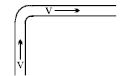
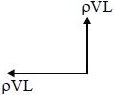
A fire hydrant delivers water of density $\rho $ at a volume rate $L$. The water travels vertically upward through the hydrant and then does $90^o$ turn to emerge horizontally at speed $V$. The pipe and nozzle have uniform cross-section throughout. The force exerted by the water on the corner of the hydrant is
Medium


Download our appand get started for free
Experience the future of education. Simply download our apps or reach out to us for more information. Let's shape the future of learning together!No signup needed.*
Similar Questions
- 1View SolutionA cube of ice has a iron piece fronzen unside at. The cube floats un a beakerfilled with water, when the ice melts then, the level of water in beaker.
- 2A beaker containing water is placed on the platform of a spring balance. The balance reads $1.5$ $kg$. A stone of mass $0.5$ $kg$ and density $500$ $kg/m^3$ is immersed in water without touching the walls of beaker. What will be the balance reading now ? ..... $kg$View Solution
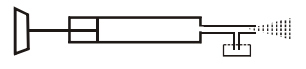
- 3A spray gun is shown in the figure where a piston pushes air out of a nozzle. A thin tube of uniform cross section is connected to the nozzle. The other end of the tube is in a small liquid container. As the piston pushes air through the nozzle, the liquid from the container rises into the nozzle and is sprayed out. For the spray gun shown, the radii of the piston and the nozzle are $20 \ mm$ and $1 \ mm$ respectively. The upper end of the container is open to the atmosphere. $Image$View Solution
$1.$ If the piston is pushed at a speed of $5 \ mms ^{-1}$, the air comes out of the nozzle with a speed of
$(A)$ $0.1 \ ms ^{-1}$ $(B)$ $1 \ ms ^{-1}$ $(C)$ $2 \ ms ^{-1}$ $(D)$ $8 \ ms ^{-1}$
$2.$ If the density of air is $\rho_{ a }$ and that of the liquid $\rho_{\ell}$, then for a given piston speed the rate (volume per unit time) at which the liquid is sprayed will be proportional to
$(A)$ $\sqrt{\frac{\rho_{ a }}{\rho_{\ell}}}$ $(B)$ $\sqrt{\rho_a \rho_{\ell}}$ $(C)$ $\sqrt{\frac{\rho_{\ell}}{\rho_{ a }}}$ $(D)$ $\rho_{\ell}$
Give the answer question $1$ and $2.$
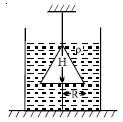
- 4A cone of radius $R$ and height $H$, is hanging inside a liquid of density $\rho$ by means of a string as shown in the figure. The force, due to the liquid acting on the slant surface of the cone isView Solution
- 5What is the velocity $v$ of a metallic ball of radius $r$ falling in a tank of liquid at the instant when its acceleration is one-half that of a freely falling body ? (The densities of metal and of liquid are $\rho$ and $\sigma$ respectively, and the viscosity of the liquid is $\eta$).View Solution
- 6View SolutionWater falls from a tap, down the streamline.
- 7We have three beakers $A, B$ and $ C $ containing glycerine, water and kerosene respectively. They are stirred vigorously and placed on a table. The liquid which comes to rest at the earliest isView Solution
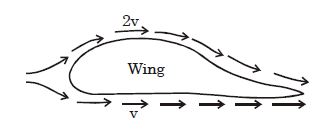
- 8The flow speeds of air on the lower and upper surfaces of the wing of an aeroplane are $v$ and $2v$ respectively. The density of air is $\rho $ and surface area of wing is $A$ . The dynamic lift on the wing isView Solution
- 9View SolutionWater containing air bubbles flows without turbulence through a horizontal pipe which has a region of narrow cross-section. In this region, the bubbles
- 10A raindrop with radius $R=0.2\, {mm}$ fells from a cloud at a height $h=2000\, {m}$ above the ground. Assume that the drop is spherical throughout its fall and the force of buoyance may be neglected, then the terminal speed attainde by the raindrop is : (In ${ms}^{-1}$)View Solution
[Density of water $f_{{w}}=1000\;{kg} {m}^{-3}$ and density of air $f_{{a}}=1.2\; {kg} {m}^{-3}, {g}=10 \;{m} / {s}^{2}$ Coefficient of viscosity of air $=18 \times 10^{-5} \;{Nsm}^{-2}$ ]