MCQ
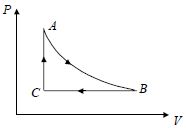
A fixed amount of a gas undergoes a thermodynamic process as shown such that heat interaction along path $B \to C \to A$ is equal to the work done by the gas along path $A \to B \to C$. Then process $A \to B$ is :-
  • A
    can only be isothermal
  • can only be adiabatic
  • C
    can be isothermal or adiabatic
  • D
    none of the above

Answer

Correct option: B.
can only be adiabatic
b
As process is cyclic $\Rightarrow \Delta \mathrm{U}_{\mathrm{ABCA}}=0$

$\Rightarrow \mathrm{Q}_{\mathrm{ABCA}}=\mathrm{W}_{\mathrm{ABCA}}$

$\Rightarrow \mathrm{Q}_{\mathrm{A} \rightarrow \mathrm{B}}+\mathrm{Q}_{\mathrm{B} \rightarrow \mathrm{C}}+\mathrm{Q}_{\mathrm{C} \rightarrow \mathrm{A}}$

$=\mathrm{W}_{\mathrm{A} \rightarrow \mathrm{B}}+\mathrm{W}_{\mathrm{B} \rightarrow \mathrm{C}}+\mathrm{W}_{\mathrm{C} \rightarrow \mathrm{A}}$   $.(1)$

Given $Q_{B \rightarrow C}+Q_{C \rightarrow A}=W_{A \rightarrow B}+W_{B \rightarrow C}$  $(2)$

Subtracting $( 2)$ from $( 1)$

$\mathrm{Q}_{\mathrm{A} \rightarrow \mathrm{B}}=\mathrm{W}_{\mathrm{C} \rightarrow \mathrm{A}}=0$

(as process $\mathrm{C} \rightarrow \mathrm{A}$ is isochoric)

process $A \rightarrow B$ is adiabatic.
Need a full question paper?

Generate a complete, print-ready paper with questions like this in minutes — across 16+ boards, with answer keys.

Start Generating Free

Similar questions

A body of mass $m$ is projected at an angle of ${45^o}$ with the horizontal. If air resistance is negligible, then total change in momentum when it strikes the ground is
A body weighs $72\; N$ on the surface of the earth. What is the gravitational force on it, at a height equal to half the radius of the earth ?
If the angular velocity of earth's spin is increased such that the bodies at the equator start floating, the duration of the day would be approximately ........ minutes

(Take : $g =10 \,ms ^{-2},$ the radius of earth, $R =6400 \times 10^{3}\, m ,$ Take $\left.\pi=3.14\right)$

Two non-ideal batteries are connected in parallel. Consider the following statements:
  1. The equivalent emf is smaller than either of the two emfs.
  2. The equivalent internal resistance is smaller than either of the two internal resistances.
  1. Both A and B are correct.
  2. A is correct but B is wrong.
  3. B is correct but A is wrong.
  4. Both A and B are wrong.
A tuning fork of frequency $340\, Hz$ is vibrated just above the tube of $120\, cm$ height. Water is poured slowly in the tube. What is the minimum height of water necessary for the resonance ... $cm$ ? (speed of sound in air $= 340\, m/s$)
In the adjacent figure, if the incline plane is smooth and the springs are identical, then the period of oscillation of this body is
A monoatomic ideal gas, initially at temperature ${T_1},$ is enclosed in a cylinder fitted with a frictionless piston. The gas is allowed to expand adiabatically to a temperature. ${T_2}$ by releasing the piston suddenly. If ${L_1}$ and ${L_2}$ are the lengths of the gas column before and after expansion respectively, then ${T_1}/{T_2}$ is given by
A thin hollow cylinder open at both ends:

$(i)$ Slides without rotating

$(ii)$ Rolls without slipping, with the same speed

A solid sphere rolls down two different inclined planes of same height, but of different inclinations. In both cases
A homogeneous solid cylindrical roller of radius $R$ and mass $M$ is pulled on a cricket pitch by a horizontal force. Assuming rolling without slipping, angular acceleration of the cylinder is