MCQ
A flat circular disc has a charge +Q uniformly distributed on the disc. A charge +q is thrown with kinetic energy E towards the disc along its normal axis. The charge q will
  • A
    Hit the disc at the centre
  • B
    Return back along its path after touching the disc
  • C
    Return back along its path without touching the disc
  • Any of the above three situations is possible depending on the magnitude of E
Answer

Correct option: D.
Any of the above three situations is possible depending on the magnitude of E

Need a full question paper?

Generate a complete, print-ready paper with questions like this in minutes — across 16+ boards, with answer keys.

Start Generating Free

Similar questions

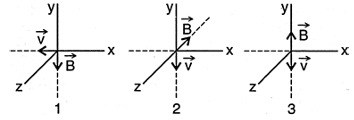
The following figure shows three situations when an electron with velocity $\vec{v}$ travels through a uniform magnetic field $\vec{B}$. In each case, what is the direction of magnetic force on the electron?
Image
de-Broglie wavelength of a body of mass m and kinetic energy $E$ is given by
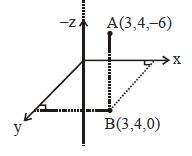
Find ratio of electric field at point $A$ and $B.$ Infinitely long uniformly charged wire with  linear charge density $\lambda$ is kept along $z-$ axis
If charge on each plate of a parallel plate capacitor is $Q$ and the magnitude of electric field between the plates is $E$ then force on each plate of a parallel plate capacitor will be
The logic behind ‘NOR’ gate is that it gives
The respective angles of the flint and crown glass prisms are $A’ $ and $A.$ They are to be used for dispersion without deviation, then the ratio of their angles $A' /A$ will be
A step-down transformer is connected to 2400 volts line and 80 amperes of current is found to flow in output load. The ratio of the turns in primary and secondary coil is 20 : 1. If transformer efficiency is 100%, then the current flowing in primary coil will be
The apparent depth of a needle lying at the bottom of the tank, which is filled with water of refractive index $1.33$ to a height of $12.5\,cm$ is measured by a microscope to be $9.4\,cm$. If water is replaced by a liquid of refractive index $1.5$ upto the same height. What distance would the microscope have to be moved to focus on the needle again ?......$cm$
Energy of electron (in $eV$) in $2^{\text {nd }}$ orbit of $He ^{+}$ ion ? (in $eV$)
If $R$ is the Rydberg’s constant for hydrogen the wave number of the first line in the Lyman series will be