Question
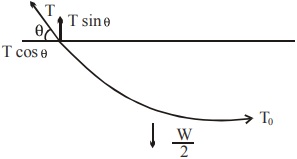
$A$ flexible chain of weight $W$ hangs between two fixed points $A$ & $B$ which are at he same horizontal level. The inclination of the chain with the horizontal at both the points of support is $\theta$ . What is the tension of the chain at the mid point? 
Answer

$\mathrm{T} \sin \theta=\frac{\mathrm{W}}{2}$

$\therefore \quad \mathrm{T}=\frac{\mathrm{W}}{2 \sin \theta}$

Also, $\mathrm{T} \cos \theta=\mathrm{T}_{0}$

$\therefore \quad \mathrm{T}_{0}=\mathrm{T} \cos \theta$

$\mathrm{T}_{0}=\frac{\mathrm{W}}{2 \sin \theta} \cos \theta$

$=\frac{W}{2} \cot \theta$

Need a full question paper?

Generate a complete, print-ready paper with questions like this in minutes — across 16+ boards, with answer keys.

Start Generating Free

Similar questions

A child stands on the edge of the cliff $10\,m$ above the ground and throws a stone horizontally with an initial speed of $5\,ms ^{-1}$. Neglecting the air resistance, the speed with which the stone hits the ground will be $..........ms ^{-1}$ (given, $g =10\,ms ^{-2}$)
A piston is slowly pushed into a metal cylinder containing an ideal gas. Which of the following statements is/are incorrect?
The excess pressure inside a soap bubble is thrice the excess pressure inside a second soap bubble. The ratio between the volume of the first and the second bubble is:
In an $\alpha -$ decay, the kinetic energy of $\alpha -$ particle is $48\, MeV$ and $Q$ value of the reaction is $50\, MeV$. The mass number of the mother nucleus is [assume that daughter nucleus is inground state]
A block kept on a rough inclined plane, as shown in the figure, remains at rest upto a maximum force $2\,N$ down the inclined plane. The maximum external force up the inclined plane that does not move the block is $10\,N.$ The coefficient of static friction between the block and the plane is : $[$Take $g = 10\,m/s^2 ]$
A siphon in use is demonstrated in the following figure. The density of the liquid flowing in siphon is $ 1.5 gm/cc. $ The pressure difference between the point $P$  and $S$ will be
In the List-$I$ below, four different paths of a particle are given as functions of time. In these functions, $\alpha$ and $\beta$ are positive constants of appropriate dimensions and $\alpha \neq \beta$. In each case, the force acting on the particle is either zero or conservative. In List-II, five physical quantities of the particle are mentioned: $\overrightarrow{ p }$ is the linear momentum, $\bar{L}$ is the angular momentum about the origin, $K$ is the kinetic energy, $U$ is the potential energy and $E$ is the total energy. Match each path in List-$I$ with those quantities in List-$II$, which are conserved for that path.
List-$I$ List-$II$
$P$ $\dot{r}(t)=\alpha t \hat{t}+\beta t \hat{j}$ $1$ $\overrightarrow{ p }$
$Q$ $\dot{r}(t)=\alpha \cos \omega t \hat{i}+\beta \sin \omega t \hat{j}$ $2$ $\overrightarrow{ L }$
$R$ $\dot{r}(t)=\alpha(\cos \omega t \hat{i}+\sin \omega t \hat{j})$ $3$ $K$
$S$ $\dot{r}(t)=\alpha t \hat{i}+\frac{\beta}{2} t^2 \hat{j}$ $4$ $U$
  $5$ $E$
Two identical particles move towards each other with velocity (2V) and (V) respectively the velocity of centre of mass
An alternating power supply of $220 \,V$ is applied across a series circuit of resistance $10 \sqrt{3} \,\Omega$, capacitive reactance $40 \,\Omega$ and inductive reactance $30 \,\Omega$. The respective currents in the circuit for zero and infinite frequencies are
The principle of controlled chain reaction is used in