MCQ
A FM Broad cast transmitter, using modulating signal of frequency $20\,kHz$ has a deviation ratio of $10$. The Bandwidth required for transmission is $.......kHz$
  • A
     $220$
  • B
    $180$
  • C
    $360$
  • $440$

Answer

Correct option: D.
$440$
d
Given

FM broadcast

Modulating frequency $=20\,k Hz = f$

Deviation ratio $=\frac{\text { frequency deviation }}{\text { modulating frequency }}=\frac{\Delta f}{ f }$

$\Rightarrow$ frequency deviation $-\Delta f = f \times 10$

$=20\,kHz \times 10=200\,kHz$

$\Rightarrow$ Bandwidth $=2( f +\Delta f )$

$=2(20+200)\,kHz$

$=440\,kHz$

Need a full question paper?

Generate a complete, print-ready paper with questions like this in minutes — across 16+ boards, with answer keys.

Start Generating Free

Similar questions

A circular coil of $20$ $turns$ and radius $10\, cm$ is placed in uniform magnetic field of $0.10\, T$ normal to the plane of the coil. If the current in coil is $5\, A$, then the torque acting on the coil will be...... $Nm$
The given figure shows, two parallel plates $A$ and $B$ of charge densities $+\sigma$ and $-\sigma$ respectively. Electric intensity will be zero in region
A potentiometer can measure emf of a cell because:
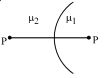
Two refracting media are separated by a spherical interface as shown in the figure. $PP’$ is the principal axis, $\mu_1$ and $\mu_2$ are the refractive indices of medium of incidence and medium of refraction respectively. Then :
The frequency of a $FM$ transmitter without signal input is called
If the amplification factor of a triode ($\mu$) is $22$ and its plate resistance is $6600 \,ohm$, then the mutual conductance of this valve is mho is
Whenever light travels from denser medium to a rarer medium:
Assume that the nuclear binding energy per nucleon $(B/A)$ versus mass number $(A)$ is as shown in the figure. Use this plot to choose the correct choice $(s)$ given below

$(A)$ Fusion of two nuclei with mass numbers lying in the range of $1 < A < 50$ will release energy

$(B)$ Fusion of two nuclei with mass numbers lying in the range of $51 < A < 100$ will release energy

$(C)$ Fission of a nucleus lying in the mass range of $100 < A < 200$ will release energy when broken into two equal fragments

$(D)$ Fission of a nucleus lying in the mass range of $200 < A < 260$ will release energy when broken into two equal fragments

The frequency of $1^{\text {st }}$ line of Balmer series in $H _2$ atom is $v _0$. The frequency of line emitted by singly ionised He atom is
The idea of secondary wavelets for the propagation of a wave was first given by