Question
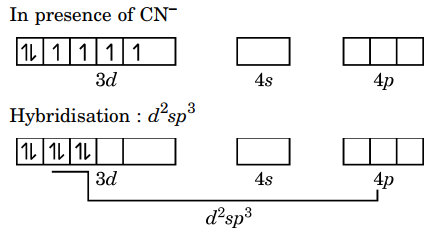
(a) For the complex $\left[ Fe ( CN )_6\right]^{4-}$, write the hybridization magnetic character and spin type of the complex. [At. Number : Fe $=26$ ]
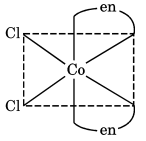
(b) Draw one of the geometrical isomers of the complex $\left.Co ( en )_2 Cl _2\right]^{+}$which is optically active.

Need a full question paper?

Generate a complete, print-ready paper with questions like this in minutes — across 16+ boards, with answer keys.

Start Generating Free

Similar questions

Write Raoult's Law for Non-Volatile solute and volatile solvent and derive it's formula.
An organic compound (A) [Molecular formula $\left.C _8 H _{10} O _2\right]$ was hydrolysed with dilute sulphuric acid to give a carboxylic acid (B) and an alcohol (C). Oxidation of (C) with chromic acid produced (B). (C) on dehydration gives but-1-ene.
Write equations for the reactions involved.
Explain the effect of substituents on the acidity of carboxylic acids.
Read the following text carefully and answer the questions that follow:
The boiling point elevation and the freezing point depression of solutions have a number of practical applications. Ethylene glycol (CH2OH-CH2OH) is used in automobile radiators as an antifreeze because it lowers the freezing point of the coolant. The same substance also helps to prevent the radiator coolant from boiling away by elevating the boiling point. Ethylene glycol has a low vapour pressure. We can also use glycerol as an antifreeze. In order for boiling point elevation to occur, the solute must be non-volatile, but no such restriction applies to freezing point depression. For example, methanol (CH3OH), a fairly volatile liquid that boils only at 65°C is sometimes used as antifreeze in automobile radiators.
i. Out of the CH3OH and C6H12O6, which is a better reagent for depression in freezing point but not for elevation in boiling point?
ii. Will the depression in freezing point be same or different, if 0.1 moles of sugar or 0.1 moles of glucose is dissolved in 1 L of water?
iii. 124 g each of the two reagents glycerol and glycol are added in 5 kg water of the radiators in the two cars. Which one is better for a car? Justify your answer.
OR
iii. If the cost of glycerol, glycol and methanol are the same, then what would be the sequence of the economy to use these compounds as antifreeze?
How would you account for the following :
(i) Of the d4 species Cr2+ is strongly reducing while manganese(III) is strongly oxidising.
(ii) Cobalt(III) is stable in aqueous but in the presence of complexing reagents it is easily oxidised.
(iii) The d1 configuration is very unstable in ions.
Write down reaction of halogens with metals. ### Give Fittig, Wurtz - Fittig and Grignard reaction of haloarene.
Indicate the steps in the preparation of :
(i) $K _2 Cr _2 O _7$ from chromite ore
(ii) $KMnO _4$ from pyrolusite ore.
Give equations for the following reactions :
(i) Oxidation of propan-1-ol with alkaline $KMnO _4$ solution.
(ii) Bromine in presence of $C S _{ 2 }$ with phenol.
(iii) Dilute nitric acid with phenol.
Explain the following:
(i) Electrophilic chlorination (substitution) of toluene.
(ii) Free radical halogenation of alkanes.
(a) Out of the following pairs, predict with reason which pair will allow greater conduction electricity:
(i) Silver wire at $30^{\circ}C$ or silver wire at $60^{\circ}C.$
(ii) 0.1 M $CH_{3}COOH$ solution or 1 M $CH_{3}COOH$ solution.
(iii) KCl solution at $20^{\circ}C$ or KCl solution at $50^{\circ}C$.
(b) Give two points of differences between electrochemical and electrolytic cells.