Question
A frame of reference that is accelerated with respect to an inertial frame of reference is called a non-inertial frame of reference. A coordinate system fixed on a circular disc rotating about a fixed axis with a constant angular velocity $\omega$ is an example of a non-intertial fiame of reference. The relationship between the force $\vec{F}_{\text {rot }}$ experienced by a particle of nass in moving on the rotating disc and the force $\vec{F}_{\text {in }}$ experienced by the particle in an inertial frame of reference is

$\vec{F}_{\text {rot }}=\vec{F}_{\text {in }}+2 m\left(\vec{v}_{\text {rot }} \times \vec{\omega}\right)+m(\vec{\omega} \times \vec{r}) \times \vec{\omega},$

where $\vec{v}_{\text {rot }}$ is the velocity of the particle in the rotating frame of reference and $\bar{r}$ is the position vector of the particle with respect to the centre of the disc.

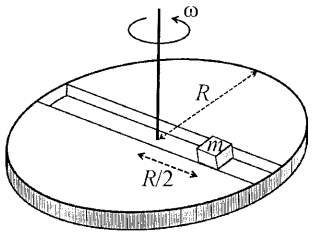
Now consider a smooth slot along a diameter of a disc of radius $R$ rotating counter-clockwise with a constant angular speed $\omega$ about its vertical axis through its center. We assign a coordinate system with the origin at the center of the disc, the $x$-axis along the slot, the $y$-axis perpendicular to the slot and the $z$-axis along the rotation axis $(\vec{\omega}=\omega \hat{k})$. A sm a $1$ block of mass $m$ is gently placed in the slot at $\vec{r}=(R / 2) \hat{i}$ at $t=0$ and is constrained to move only along the slot.

(Image)

($1$) The distance $r$ of the block at time $t$ is

($A$) $\frac{R}{4}\left(e^{\omega t}+e^{-\omega t}\right)$   ($B$) $\frac{R}{2} \cos \omega t$   ($C$) $\frac{R}{4}\left(e^{2 \omega t}+e^{-2 \omega t}\right)$

($D$) $\frac{F}{2} \cos 2 \omega t$

($2$) The net reaction of the disc on the block is

($A$) $\frac{1}{2} m \omega^2 R\left(e^{2 \omega t}-e^{-2 \omega t}\right) \hat{j}+m g \hat{k}$

($B$) $\frac{1}{2} m \omega^2 R\left(e^{\omega t}-e^{-a t t}\right) j+m g k$

($C$) $-m \omega^2 R \cos \omega t \hat{j}-m g \hat{k}$

($D$) $m \omega^2 R \sin \omega t \hat{j}-m g \hat{k}$

Give the answer quetioin ($1$) ($2$)
Answer

$1.$ $\text { Force on the block along slat }=m r \omega^2=m v \frac{d v}{d r}$

$\therefore \int_o^v V d v=\int_{R / 2}^r \omega^2 r d r \Rightarrow V=\omega \sqrt{r^2-\frac{R^2}{4}}=\frac{d r}{d t}$

$\therefore \int_{R / 2}^r \frac{d r}{\sqrt{r^2-\frac{R^2}{4}}}=\int_o^t \omega d t$

On solving we get

$r+\sqrt{r^2-\frac{R^2}{4}}=\frac{R}{2} e^{w t}$

or $r^2-\frac{R^2}{4}=\frac{R^2}{4} e^{2 w t}+r^2-2 r \frac{R}{2} e^{w t}$

$\therefore r=\frac{R}{4}\left(e^{w t}+e^{-w t}\right)$

Need a full question paper?

Generate a complete, print-ready paper with questions like this in minutes — across 16+ boards, with answer keys.

Start Generating Free

Similar questions

Two coil $A$ and $B$ have coefficient of mutual inductance $M = 2H$. The magnetic flux passing through coil $A$ changes by $4$ Weber in $10$ seconds due to the change in current in $B$. Then
Adielectric slab is inserted between the plates of an isolated charged capacitor. Which of the following quantities will remain the same?
In a vibration magnetometer, the time period of a bar magnet oscillating in horizontal component of earth's magnetic field is $2$ $sec$. When a magnet is brought near and parallel to it, the time period reduces to $1 $ $sec$. The ratio $H/F $ of the horizontal component $H$  and the field $F$ due to magnet will be
If an object is projected vertically upwards with speed, half the escape speed of earth, then the maximum height attained by it is [ $R$ is radius of earth]
At the highest point of the path of a projectile, its
Positive rays was discovered by
The quantities which have the same dimensions as those of solid angle are:
Only $2 \%$ of the optical source frequency is the available channel bandwidth for an optical communicating system operating at $1000 \,nm$. If an audio signal requires a bandwidth of $8 \,kHz$, how many channels can be accommodated for transmission
An $8\,m$ long copper wire and $4\,m$ long steel wire, each of cross section $0.5\,cm^2$ are fastened end to end and stretched by $500\,N$ force. The elastic potential energy of the system is (Youngs mod $: Y_{cu}= 1\times 10^{11}\,N/m^2,$ $Y_{steel} = 2\times 10^{11}\,N/m^2$ ) :
The moment of inertia of a meter scale of mass $0.6\, kg$ about an axis perpendicular to the scale and  located at the $20\, cm$ position on the scale in $kg \,m^2$ is  (Breadth of the scale is negligible