MCQ
A frame of reference that is accelerated with respect to an inertial frame of reference is called a non-inertial frame of reference. A coordinate system fixed on a circular disc rotating about a fixed axis with a constant angular velocity $\omega$ is an example of a non-intertial fiame of reference. The relationship between the force $\vec{F}_{\text {rot }}$ experienced by a particle of nass in moving on the rotating disc and the force $\vec{F}_{\text {in }}$ experienced by the particle in an inertial frame of reference is

$\vec{F}_{\text {rot }}=\vec{F}_{\text {in }}+2 m\left(\vec{v}_{\text {rot }} \times \vec{\omega}\right)+m(\vec{\omega} \times \vec{r}) \times \vec{\omega},$

where $\vec{v}_{\text {rot }}$ is the velocity of the particle in the rotating frame of reference and $\bar{r}$ is the position vector of the particle with respect to the centre of the disc.

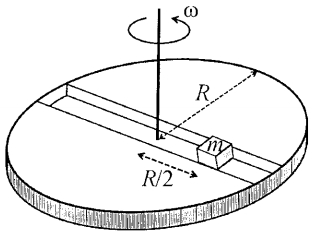
Now consider a smooth slot along a diameter of a disc of radius $R$ rotating counter-clockwise with a constant angular speed $\omega$ about its vertical axis through its center. We assign a coordinate system with the origin at the center of the disc, the $x$-axis along the slot, the $y$-axis perpendicular to the slot and the $z$-axis along the rotation axis $(\vec{\omega}=\omega \hat{k})$. A sm a $1$ block of mass $m$ is gently placed in the slot at $\vec{r}=(R / 2) \hat{i}$ at $t=0$ and is constrained to move only along the slot.

(Image)

($1$) The distance $r$ of the block at time $t$ is

($A$) $\frac{R}{4}\left(e^{\omega t}+e^{-\omega t}\right)$   ($B$) $\frac{R}{2} \cos \omega t$   ($C$) $\frac{R}{4}\left(e^{2 \omega t}+e^{-2 \omega t}\right)$

($D$) $\frac{F}{2} \cos 2 \omega t$

($2$) The net reaction of the disc on the block is

($A$) $\frac{1}{2} m \omega^2 R\left(e^{2 \omega t}-e^{-2 \omega t}\right) \hat{j}+m g \hat{k}$

($B$) $\frac{1}{2} m \omega^2 R\left(e^{\omega t}-e^{-a t t}\right) j+m g k$

($C$) $-m \omega^2 R \cos \omega t \hat{j}-m g \hat{k}$

($D$) $m \omega^2 R \sin \omega t \hat{j}-m g \hat{k}$

Give the answer quetioin ($1$) ($2$)
  • $A,B$
  • B
    $A,C$
  • C
    $A,D$
  • D
    $A,B,C$

Answer

Correct option: A.
$A,B$
a
$1.$ $\text { Force on the block along slat }=m r \omega^2=m v \frac{d v}{d r}$

$\therefore \int_o^v V d v=\int_{R / 2}^r \omega^2 r d r \Rightarrow V=\omega \sqrt{r^2-\frac{R^2}{4}}=\frac{d r}{d t}$

$\therefore \int_{R / 2}^r \frac{d r}{\sqrt{r^2-\frac{R^2}{4}}}=\int_o^t \omega d t$

On solving we get

$r+\sqrt{r^2-\frac{R^2}{4}}=\frac{R}{2} e^{w t}$

or $r^2-\frac{R^2}{4}=\frac{R^2}{4} e^{2 w t}+r^2-2 r \frac{R}{2} e^{w t}$

$\therefore r=\frac{R}{4}\left(e^{w t}+e^{-w t}\right)$

Need a full question paper?

Generate a complete, print-ready paper with questions like this in minutes — across 16+ boards, with answer keys.

Start Generating Free

Similar questions

For an adiabatic expansion of an ideal gas, the fractional change in its pressure is equal to (where $\gamma$ is the ratio of specific heats):
$A$ ball of mass $m$ is attached to the lower end of light vertical spring of force constant $k$. The upper end of the spring is fixed. The ball is released from rest with the spring at its normal (unstretched) length, comes to rest again after descending through a distance $x.$
Two sound sources when sounded simultaneously produce four beats in $0.25$ second. the difference in their frequencies must be
If two moles of diatomic gas and one mole of mono atomic gas are mixed then the ratio of specific heats $\gamma=$ ......
Pressure $Vs$ temperature graph of an ideal gas is shown in figure. Density of the gas at point $A$ is $\rho _0$ , Density at $B$ will be
A damped harmonic oscillator has a frequency of $5$ oscillations per second. The amplitude drops to half its value for every $10$ oscillations. The time it will take to drop to $\frac{1}{1000}$ of the original amplitude is close to .... $s$
The displacement of a particle from a point having position vector $2 \hat{i}+4 \hat{j}$ to another point having position vector $5 \hat{i}+1 \hat{j}$ is ........ units
A student uses a simple pendulum of exactly $1 \mathrm{~m}$ length to determine $\mathrm{g}$, the acceleration due to gravity. He uses a stop watch with the least count of $1 \mathrm{sec}$ for this and records $40$ seconds for $20$ oscillations. For this observation, which of the following statement$(s)$ is (are) true?

$(A)$ Error $\Delta T$ in measuring $T$, the time period, is $0.05$ seconds

$(B)$ Error $\Delta \mathrm{T}$ in measuring $\mathrm{T}$, the time period, is $1$ second

$(C)$ Percentage error in the determination of $g$ is $5 \%$

$(D)$ Percentage error in the determination of $g$ is $2.5 \%$

The velocity $u$ and displacement $r$ of a body are related as $u^2 = kr$, where $k$ is a constant. What will be the velocity after $1\, second$ ? (Given that the displacement is zero at $t = 0$)
A ball hits the floor and rebounds after inelastic collision. In this case