Question
A free neutron decays into a proton, an electron and

Answer

$_0{n^1}{ = _1}{p^1}{ + _{ - 1}}{e^0} + \bar \nu $
Antineutrino is required for conservation of spin.

Need a full question paper?

Generate a complete, print-ready paper with questions like this in minutes — across 16+ boards, with answer keys.
Start Generating Free

Similar questions

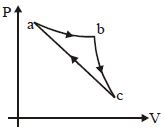
In the $P-V$ diagram shown, the gas does $5\, J$ of work in isothermal process $ab$ and $4\,J$ in adiabatic process $bc$.   .... $J$ will be the change in internal energy of the gas in straight path $c$ to $a$ ?
During an adiabatic expansion of $2\, moles$ of a gas, the change in internal energy was found $-50J.$ The work done during the process is ...... $J$
The plane surface of a plano-convex lens of focal length $ f$ is silvered. It will behave as
Image formed on the retina is
In $LC$ circuit the inductance $\mathrm{L}=40\; \mathrm{mH}$ and capacitance $\mathrm{C}=100\; \mu \mathrm{F} .$ If a voltage $\mathrm{V}(\mathrm{t})=10 \sin (314 \mathrm{t})$ is applied to the circuit, the current in the circuit is given as 
Two identical capacitors have same capacitance $C$. One of them is charged to the potential $\mathrm{V}$ and other to the potential $2 \mathrm{~V}$. The negative ends of both are connected together. When the positive ends are also joined together, the decrease in energy of the combined system is :
Inductance $L$ can be dimensionally represented as
An earthquake generates both transverse $(S)$ and longitudinal $(P)$ sound waves in the earth. The speed of $S$ waves is about $4.5 \,km/s$ and that of $P$ waves is about $8.0 \,km/s.$ A seismograph records $P$ and $S$ waves from an earthquake. The first $P$ wave arrives $4.0\, min$ before the first $S$ wave. The epicenter of the earthquake is located at a distance about .... $km$
Four wires $AB,\,\,BC,\,\,CD,\,\,DA$ of resistance $4\, \Omega$ each and a fifth wire $BD$ of resistance $8\, \Omega$ are joined to form a rectangle $ABCD$ of which $BD$ is a diagonal. The effective resistance between the points $A$ and $B$ is
A big drop is formed by coalescing $1000$ small identical drops of water. If $E_1$ be the total surface energy of $1000$ small drops of water and $E_2$ be the surface energy of single big drop of water, the $E_1$ : $\mathrm{E}_2$ is $\mathrm{x}: 1$ where $x$ =_____.