MCQ
A function $f$ from the set of natural numbers to integers defined by $f(n) = \left\{ \begin{array}{l}\frac{{n - 1}}{2},\;{\rm{when}}\;n\;{\rm{is}}\;{\rm{odd}}\\ - \frac{n}{2},\;{\rm{when\, }}n{\rm{\, is\, even}}\end{array} \right.$, is
  • A
    One$-$one but not onto
  • B
    Onto but not one$-$one
  • One$-$one and onto both
  • D
    Neither one$-$one nor onto

Answer

Correct option: C.
One$-$one and onto both
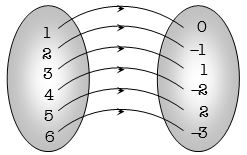
$f:N \to I$$f(1) = 0,\,f(2) = - 1,\,f(3) = 1,\,f(4) = - 2,\,f(5) = 2$
and $f(6) = - 3$ so on.
In this type of function every element of set $A$ has unique image in set $B$ and there is no element left in set $B$. 
Hence $f$ is one$-$one and onto function.

Need a full question paper?

Generate a complete, print-ready paper with questions like this in minutes — across 16+ boards, with answer keys.

Start Generating Free

Similar questions

Let $V = 2i + j - k$ and $W = i + 3k$. If $U$ is a unit vector, then the maximum value of the scalar triple product $[U V W]$ is
The differential equation of the family of parabolas with focus at the origin and the $x$-axis as axis is
If $\alpha, \beta $ be the roots of ${x^2} + px + q = 0$ and $\alpha + h,\,\beta + h$ are the roots of ${x^2} + rx + s = 0$, then
If $f(x)$ is a continuous and differentiable function satisfying $f(x).f(f(x)) = x^2 + 1, \, f(1) = 2, \,f'(1) = k$, then the value of $f'(2)$ is
If ${ }^{1} \mathrm{P}_{1}+2 \cdot{ }^{2} \mathrm{P}_{2}+3 \cdot{ }^{3} \mathrm{P}_{3}+\ldots+15 \cdot{ }^{15} \mathrm{P}_{15}={ }^{\mathrm{q}} \mathrm{P}_{\mathrm{r}}-\mathrm{s}, 0 \leq \mathrm{s} \leq 1$ then ${ }^{\mathrm{q}+\mathrm{s}} \mathrm{C}_{\mathrm{r}-\mathrm{s}}$ is equal to .... .
If $\sin x=-\frac{3}{5},$ where $\pi$ then $80\left(\tan ^2 x-\cos x\right)$ is equal to :
If the sides $A B, B C$ and $C A$ of a triangle $A B C$ have $3,5$ and $6$ interior points respectively, then the total number of triangles that can be constructed using these points as vertices, is equal to ....... .
If $\theta = {\sin ^{ - 1}}x + {\cos ^{ - 1}}x - {\tan ^{ - 1}}x,x \ge 0$, then the smallest interval in which $\theta $ lies is given by
Tangents are drawn to a unit circle with centre at the origin from each point on the line $2x + y = 4$. Then the equation to the locus of the middle point of the chord of contact is
Maximum value of $f(x) = \sin x + \cos x$ is