MCQ
A function $f$ from the set of natural numbers to integers defined by $f(n) = \left\{ \begin{array}{l}\frac{{n - 1}}{2},\;{\rm{when}}\;n\;{\rm{is}}\;{\rm{odd}}\\ - \frac{n}{2},\;{\rm{when\, }}n{\rm{\, is\, even}}\end{array} \right.$, is
  • A
    One-one but not onto
  • B
    Onto but not one-one
  • One-one and onto both
  • D
    Neither one-one nor onto

Answer

Correct option: C.
One-one and onto both
c
(c) $f:N \to I$

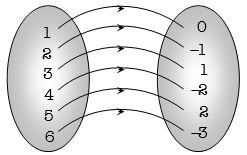
$f(1) = 0,\,f(2) = - 1,\,f(3) = 1,\,f(4) = - 2,\,f(5) = 2$

and $f(6) = - 3$ so on.

In this type of function every element of set $A$ has unique image in set $B$ and there is no element left in set $B$. 

Hence $f$ is one-one and onto function.

Need a full question paper?

Generate a complete, print-ready paper with questions like this in minutes — across 16+ boards, with answer keys.

Start Generating Free

Similar questions

vectors $\vec{\text{a}}$ and $\vec{\text{b}}$ are inclined at angle $\theta=120^\circ.$ if $|\vec{\text{a}}|=1,\big|\vec{\text{b}}\big|=2,$ then $\big[\big(\vec{\text{a}}+3\vec{\text{b}}\big)\times\big(3\vec{\text{a}}-\vec{\text{b}}\big)\big]^2$ is equal to:
  1. 300
  2. 325
  3. 275
  4. 225
The positive integral solution of the equation

$\tan^{-1}\text{x}+\cos^{-1}\frac{\text{y}}{\sqrt{1+\text{y}^2}}=\sin^{-1}\frac{3}{\sqrt{10}}$ is:

  1. x = 1, y = 2
  2. x = 2, y = 1
  3. x = 3, y = 2
  4. x = -2, y = -1
For two $3\times3$ matrices $A$ and $B$ , let $A+ B\, = 2B'$ and $3A + 2B\, = I_3$, where $B'$ is the transpose of $B$ and $I_3$ is $3\times3$ identity matrix. Then
The least value of the function f(x) = x3 - 18x2 + 96x in the interval [0, 9] is:
  1. 126
  2. 135
  3. 160
  4. 0
If the graph of non-constant function is symmetric about the point $(3,4)$ , then the value of $\sum\limits_{r = 0}^6 {f(r) + f(3)} $ is equal to
A coin is tossed $3$ times. The probability of getting exactly two heads is
Consider the function $f (x) = x^3 - 8x^2 + 20x -13$
Area enclosed by $y = f (x)$ and the co-ordinate axes is
$\int\tan^{-1}\sqrt{\text{xdx}}$ is equal to:
  1. $(\text{x}+1)\tan^{-1}\sqrt{\text{x}}-\sqrt{\text{x}}+\text{c}$
  2. $\text{x}\tan^{-1}\sqrt{\text{x}}-\sqrt{\text{x}}+\text{c}$
  3. $\sqrt{\text{x}}-\text{x}\tan^{-1}\sqrt{\text{x}}+\text{c}$
  4. $\sqrt{\text{x}}-(\text{x}+1)\tan^{-1}\sqrt{\text{x}}+\text{c}$
Can $\frac{1}{\sqrt{3}},\frac{2}{\sqrt{3}},\frac{-2}{\sqrt{3}}$ be the direction cosines of any directed line:
  1. Yes
  2. No
  3. Cannot say
  4. None of these
Mark the correct alternative in the following question for the binary operation * on Z defined by a * b = a + b + 1, the identity element is:
  1. 0
  2. -1
  3. 1
  4. 2