MCQ
A function $f$ from the set of natural numbers to integers defined by $f(n) = \left\{ \begin{array}{l}\frac{{n - 1}}{2},\;{\rm{when}}\;n\;{\rm{is}}\;{\rm{odd}}\\ - \frac{n}{2},\;{\rm{when\, }}n{\rm{\, is\, even}}\end{array} \right.$, is
  • A
    One-one but not onto
  • B
    Onto but not one-one
  • One-one and onto both
  • D
    Neither one-one nor onto

Answer

Correct option: C.
One-one and onto both
c
(c) $f:N \to I$

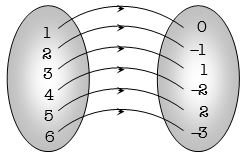
$f(1) = 0,\,f(2) = - 1,\,f(3) = 1,\,f(4) = - 2,\,f(5) = 2$

and $f(6) = - 3$ so on.

In this type of function every element of set $A$ has unique image in set $B$ and there is no element left in set $B$. 

Hence $f$ is one-one and onto function.

Need a full question paper?

Generate a complete, print-ready paper with questions like this in minutes — across 16+ boards, with answer keys.

Start Generating Free

Similar questions

The distance of the plane $2x - 3y + 6z + 7 = 0$ from the point $(2, -3, -1)$ is:
If the points $(p, 0), (0, q)$ and $(1, 1)$ are collinear, then $\frac{1}{\text{p}}+\frac{1}{\text{q}}$​ is equal to:
Choose the correct answers from the given four options: If $\text{y}=\sqrt{\sin\text{x}+\text{y}},$ then $\frac{\text{dy}}{\text{dx}}$ is equal to:
Let $f : R \rightarrow R$ be given by $\text{f(x)}=\tan\text{x}.$ Then, $f^{-1}(1)$ is:
The maximum value of

$f(x)=\left|\begin{array}{ccc} \sin ^{2} x & 1+\cos ^{2} x & \cos 2 x \\ 1+\sin ^{2} x & \cos ^{2} x & \cos 2 x \\ \sin ^{2} x & \cos ^{2} x & \sin 2 x \end{array}\right|, x \in R \text { is }$

The feasible region is :
Given $f(x) = -\frac{{{x^3}}}{3} + x^2 sin 1.5 a - x sin a . sin 2a - 5 \,\,sin^{-1} (a^2 - 8a + 17)$ then :
lf  $f(x)$  is a differentiable function in the interval $(0,\infty )$  such that $f(1) = 1$ and $\mathop {\lim }\limits_{t \to x} \frac{{{t^2}f(x) - {x^2}f(t)}}{{t - x}} = 1,$ for each $x > 0,$  then $f (\frac {3}{2})$ is equal to
The value of $\theta$ lying between $- \,\frac{\pi }{4}$ and $\frac{\pi }{2}$ and $0 \le A \le \frac{\pi }{2}$ and satisfying the equation $\left| {\begin{array}{*{20}{c}}{1\, + \,{{\sin }^2}A}&{{{\cos }^2}A}&{2\,\sin \,4\theta }\\{{{\sin }^2}A}&{1\, + \,{{\cos }^2}A}&{2\,\sin \,4\theta }\\{{{\sin }^2}A}&{{{\cos }^2}A}&{1\, + \,2\,\sin \,4\theta }\end{array}} \right|$ $= 0$ are :
The order and degree of the differential equation ${\left[ {4 + {{\left( {\frac{{dy}}{{dx}}} \right)}^2}} \right]^{2/3}} = \frac{{{d^2}y}}{{d{x^2}}}$ are