MCQ
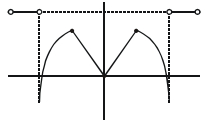
A function $f$ is defined on $[-3,3]$ as

$f(x)=\left\{\begin{array}{cc}\min \left\{|x|, 2-x^{2}\right\} & , \quad-2 \leq x \leq 2 \\ {[|x|]} & , \quad 2<|x| \leq 3\end{array}\right.$

where $[x]$ denotes the greatest integer $\leq x .$ The number of points, where $f$ is not differentiable in $(-3,3)$ is

  • A
    $10$
  • B
    $2$
  • $5$
  • D
    $8$

Answer

Correct option: C.
$5$
c
$f(x)=\left\{\begin{array}{cc}\min \left\{|x|, 2-x^{2}\right\} & , \quad-2 \leq x \leq 2 \\ {[|x|]} & , \quad 2<|x| \leq 3\end{array}\right.$

$\Rightarrow x \in[-3,-2) \cup(2,3]$

Number of points of non-differentiability in $(-3,3)=5$

Need a full question paper?

Generate a complete, print-ready paper with questions like this in minutes — across 16+ boards, with answer keys.

Start Generating Free

Similar questions

Two or more vectors having the same initial point are:
Choose the correct answer from given four options in each of the Exercise:If $x, y, z$ are all different from zero and $\begin{vmatrix}1+\text{x}&1&1\\1&1+\text{y}&1\\1&1&1+\text{z}\end{vmatrix}=0,$ then the value of $x^{-1} + y^{-1} + z^{-1}$ is:
Consider the set of eight vectors $V=\{a \hat{i}+b \hat{j}+c \hat{k}: a, b, c \in\{-1,1\}\}$. Three non-coplanar vectors can be chosen from $V$ in $2^p$ ways. Then $p$ is
Choose the correct answer from the given four options. Find the value of $\lambda$ such that the vectors $\vec{\text{a}}=2\hat{\text{i}}+\lambda\hat{\text{j}}+\hat{\text{k}}$ and $\vec{\text{a}}=\hat{\text{i}}+2\hat{\text{j}}+3\hat{\text{k}}$ are orthogonal:
If $\cos^{-1}\text{x}>\sin^{-1}\text{x},$ then:
Let $f(x)$ be a differentiable function in $[0, 2], f(0) = 0$ and $f'(x) \le \frac{1}{2}\,\forall x \in \left[ {0,\,2} \right]$ . Then
The number of distinct real roots of $\begin{vmatrix}\text{cosec}&\sec\text{x}&\sec\text{x}\\\sec\text{x}&\text{cosec}\text{x}&\sec\text{x}\\\sec\text{x}&\sec\text{x}&\text{cosecx}\end{vmatrix}=0$ lies in the interval $-\frac{\pi}{4}\leq\text{x}\leq\frac{\pi}{4}$ is:
If solution of differential equation $\frac{{dy}}{{dx}} = \frac{{1 + x}}{{2y}}$ is a conic passing through point $(1,1),$ then its eccentricity, is-
If $\frac{{dy}}{{dx}} + y\tan x = \sin 2x$ and $y(0)\,=1$ , then $y(\pi)$ is equal to
If $S = [S_{ij}]$ is a scalar matrix such that $S_{ij} = k$ and $A$ is a square matrix of the same order, then $AS = SA = ?$