Question
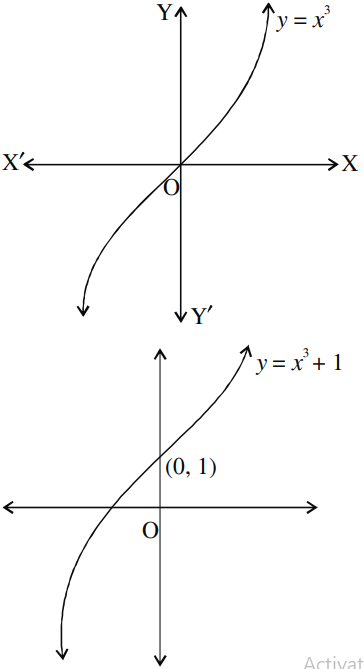
A function $f: R \rightarrow R$ is defined such that $f(x)=x^3$ +1 , then function :

Answer

(D)
Image
It is clear from graph, function is neither maximum nor minimum value.

Need a full question paper?

Generate a complete, print-ready paper with questions like this in minutes — across 16+ boards, with answer keys.
Start Generating Free

Similar questions

The relation $R$ in the set $\{1,2,3\}$ given by $R=\{(1,2)$, $(2,1),(1,1)\}$ is
$\sin^{−1}\text{x}+\sin^{−1}\frac{1}{\text{x}}+\cos^{−1}\text{x}+\cos^{−1}\frac{1}{\text{x}}=$
  1. π
  2. $ \cfrac{3\pi}{2}$
  3. None of these
Choose the correct answer from given four options in each of the Exercise:
The determinant $\begin{vmatrix}\text{b}^2-\text{ab}&\text{b}-\text{c}&\text{bc}-\text{ac}\\\text{ab}-\text{a}^2&\text{a}-\text{b}&\text{b}^2-\text{ab}\\\text{bc}-\text{ac}&\text{c}-\text{a}&\text{ab}-\text{a}^2\end{vmatrix}$ equals to:
The area enclosed between the curve $y^2=4 x$ and the line $y=x$ is
The order and degree respectively of the differential equation $\frac{d^2 y}{d x^2}+\left(\frac{d y}{d x}\right)^{\frac{1}{4}}+x^{\frac{1}{5}}=0$, are
The value of p and q for which the function $f ( x )=\left\{\begin{array}{cl}\frac{\sin (p+1) x+\sin x}{x} & , x<0 \\ \frac{q}{x^2} & , x=0 \\ \frac{\sqrt{x+b x^2}-\sqrt{x}}{x^{\frac{3}{2}}} & , x>0\end{array}\right.$ is continuous for all $x \in R$, are
If $\vec{\text{a}} $ lies in the plane of vectors $\vec{\text{b}}$ and $\vec{\text{c}},$ then which of the following is correct?
  1. $\big[\vec{\text{a}}\vec{\text{b}}\vec{\text{c}}\big]=0$
  2. $\big[\vec{\text{a}}\vec{\text{b}}\vec{\text{c}}\big]=1$
  3. $\big[\vec{\text{a}}\vec{\text{b}}\vec{\text{c}}\big]=3$
  4. $\big[\vec{\text{b}}\vec{\text{c}}\vec{\text{a}}\big]=1$
In a regular hexagon ABCDEF, $\overrightarrow{\text{AB}}=\vec{\text{a}},\ \overrightarrow{\text{BC}}=\vec{\text{b}}$ and $\overrightarrow{\text{CD}}=\vec{\text{c}}$. Then, $\overrightarrow{\text{AE}}=$
  1. $\vec{\text{a}}+\vec{\text{b}}+\vec{\text{c}}$
  2. $2\vec{\text{a}}+\vec{\text{b}}+\vec{\text{c}}$
  3. $\vec{\text{b}}+\vec{\text{c}}$
  4. $\vec{\text{a}}+2\vec{\text{b}}+2\vec{\text{c}}$
If $A$ and $B$ are $2 \times 2$ matrices, then which of the following is true?
If X is a binomial variate with parameters n and p, where 0 < p < 1 such that $\frac{\text{P(X = r)}}{\text{P(X = n - r})}$ is independent of n and r, then p equals:
  1. $\frac{1}{2}$
  2. $\frac{1}{3}$
  3. $\frac{1}{4}$
  4. $\text{None of these}$