MCQ
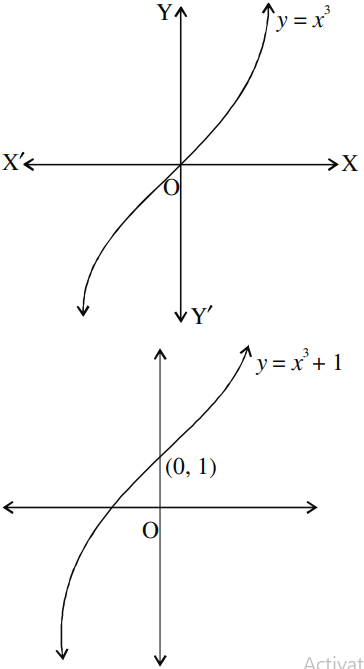
A function $f: R \rightarrow R$ is defined such that $f(x)=x^3$ +1 , then function :
  • A
    is not any maximum value
  • B
    is not any minimum value
  • C
    is maximum and minimum value
  • is neither maximum nor minimum value

Answer

Correct option: D.
is neither maximum nor minimum value
(D)
Image
It is clear from graph, function is neither maximum nor minimum value.

Need a full question paper?

Generate a complete, print-ready paper with questions like this in minutes — across 16+ boards, with answer keys.

Start Generating Free

Similar questions

The general solution of the differential equation $\frac{y d x-x d y}{y}=0$ is _________.
If A = {1, 2, 3}, B = {1, 4, 6, 9} and R is a relation from A to B defined by 'x is greater than y'. The range of R is:
  1. {1, 4, 6, 9}
  2. {4, 6, 9}
  3. {1}
  4. None of these.
Which of the following is not correct for relation $\mathrm{R}$ on the set of real numbers ?
Suppose $f(x)$ is differentiable at $x = 1$ and $\mathop {\lim }\limits_{h \to 0} \frac{1}{h}f(1 + h) = 5$, then $f'(1)$ equals
How many reflexive relations are possible in a set $A$ whose $n(A)=3$ ?
Let $a, b \in \mathbb{R}$ and $f: \mathbb{R} \rightarrow \mathbb{R}$ be defined by $f(x)=a \cos \left(\left|x^3-x\right|\right)+b|x| \sin \left(\left|t^3+x\right|\right)$. Then $f$ is

($A$) differentiable at $x=0$ if $a=0$ and $b=1$

($B$) differentiable at $x=1$ if $a=1$ and $b=0$

($C$) $NOT$ differentiable at $x=0$ if $a=1$ and $b=0$

($D$) $NOT$ differentiable at $x=1$ if $a=1$ and $b=1$

The angle between the straight lines $\frac{{x + 1}}{2} = \frac{{y - 2}}{5} = \frac{{z + 3}}{4}$ and $\frac{{x - 1}}{1} = \frac{{y + 2}}{2} = \frac{{z - 3}}{{ - 3}}$ is ......... $^o$
$\int\frac{\text{x+sin x}}{1+\text{cos x}}$ dx is equal to:
  1. $\log|1+\cos\text{x}|+\text{c}$
  2. $\log|\text{x}+\sin\text{x}|+\text{c}$
  3. $\text{x}-\tan+\text{c}$
  4. $\text{x}.\text{tan}\frac{\text{x}}{2}+\text{c}$
For which interval, the function ${{{x^2} - 3x} \over {x - 1}}$ satisfies all the conditions of Rolle's theorem
If $y = {{\sqrt {a + x} - \sqrt {a - x} } \over {\sqrt {a + x} + \sqrt {a - x} }}$, then ${{dy} \over {dx}} = $