Question
A function f(x) is said to be continuous in an open interval (a, b), if it is continuous at every point in this interval.
A function f(x) is said to be continuous in the closed interval [a, b), if f(x) is continuous in (a, b) and $\lim\limits_{\text{x}\rightarrow0}\text{f}(\text{a}+\text{h})=\text{f}(\text{a})$ and $\lim\limits_{\text{x}\rightarrow0}\text{f}(\text{b}-\text{h})=\text{f}(\text{b})$
If function $\text{f}(\text{x})=\begin{cases}\frac{\sin(\text{a}+1)\text{x}+\sin\text{x}}{\text{x}}&,\text{x}<0\\\text{c}&,\text{x}=0\\\frac{\sqrt{\text{x}+\text{bx}^2}-\sqrt{\text{x}}}{\text{bx}^{\frac{3}{2}}}&,\text{x}>0\end{cases}$ is continuous at x = 0, then answer the following questions.
  1. The value of a is:
  1. $-\frac{3}{2}$
  2. $0$
  3. $\frac{1}{2}$
  4. $-\frac{1}{2}$
  1. The value of b is:
  1. 1
  2. -1
  3. 0
  4. Any real number.
  1. The value of c is:
  1. $1$
  2. $\frac{1}{2}$
  3. $-1$
  4. $-\frac{1}{2}$
  1. The value of a + c is:
  1. 1
  2. 0
  3. -1
  4. -2
  1. The value of c - a is:
  1. 1
  2. 0
  3. -1
  4. 2

Answer

$\text{L.H.L.}(\text{at x})=\lim\limits_{\text{x}\rightarrow0}\frac{\sin(\text{a}+1)\text{x}+\sin\text{x}}{\text{x}}\Big(\frac{0}{0}\text{ form}\Big)$ Using L' Hospital rule, we get $\text{L.H.L.} (\text{at x} = 0)$ $=\lim\limits_{\text{x}\rightarrow0}(\text{a}+1)\cos(\text{a}+1)\text{x}+\cos\text{x}=\text{a}+2$ $\text{R.H.L.} (\text{at x} = 0)=\lim\limits_{\text{x}\rightarrow0}\frac{\sqrt{\text{x}+\text{bx}^2}-\sqrt{\text{x}}}{\text{bx}^\frac{3}{2}}=\lim\limits_{\text{x}\rightarrow0}\frac{\sqrt{1+\text{bx}}-1}{\text{bx}}$ $=\lim\limits_{\text{x}\rightarrow0}\frac{1}{\sqrt{1+\text{bx}}+1}=\frac{1}{2}$ Since,f(x) is continuous at x = 0. $\therefore$ From (i) and (ii), we get $\text{a}+2=\text{c}=\frac{1}{2}\Rightarrow\text{a}=-\frac{3}{2},\text{c}=\frac{1}{2}$ Also, value of b does not affect the continuity of f(x), so b can be any real number.
  1. (a) $-\frac{3}{2}$
  1. (d) Any real number.
  1. (b) $\frac{1}{2}$
  1. (c) -1
Solution:
$\text{a}+\text{c}=-\frac{3}{2}+\frac{1}{2}=-1$
  1. (d) 2
Solution:
$\text{c}-\text{a}=\frac{1}{2}+\frac{3}{2}=2$

Need a full question paper?

Generate a complete, print-ready paper with questions like this in minutes — across 16+ boards, with answer keys.

Start Generating Free

Similar questions

In a college hostel accommodating 1000 students, one of the hostellers came in carrying Corona virus, and the hostel was isolated. The rate at which the virus spreads is assumed to be proportional to the product of the number of infected students and remaining students. There are 50 infected students after 4 days.

Based on the above information, answer the following questions.
  1. If n(I) denote the number of students infected by Corona virus at any time I, then maximum value of n(I) is:
  1. 50
  2. 100
  3. 500
  4. 1000
  1. $\frac{\text{dn}}{\text{dt}}$ is proporuona to:
  1. n(1000 - n)
  2. n(100 + n)
  3. n(100 - n)
  4. n(100 + n)
  1. The value of n(4) is:
  1. 1
  2. 50
  3. 100
  4. 1000
  1. The most general solution of differential equation formed in given situation is:
  1. $\frac{1}{1000}\log\Big(\frac{1000-\text{n}}{\text{n}}\Big)=\lambda\text{t}+\text{c}$
  2. $\log\Big(\frac{\text{n}}{100-\text{n}}\Big)=\lambda\text{t}+\text{c}$
  3. $\frac{1}{1000}\log\Big(\frac{\text{n}}{1000-\text{n}}\Big)=\lambda\text{t}+\text{c}$
  4. None of these.
  1. The value of n at any time is given by:
  1. $\text{n(t)}=\frac{1000}{1+999\text{e}^{-0.9906\text{t}}}$
  2. $\text{n(t)}=\frac{1000}{1-999\text{e}^{-0.9906\text{t}}}$
  3. $\text{n(t)}=\frac{100}{1-999\text{e}^{-0.9906\text{t}}}$
  4. $\text{n(t)}=\frac{100}{1+999\text{e}^{-0.9906\text{t}}}$
Read the following passage and answer the questions given below. 

Image

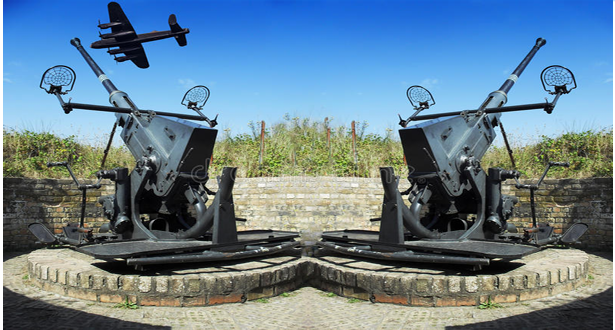
There are two antiaircraft guns, named as A and B. The probabilities that the shell fired from them hits an airplane are 0.3 and 0.2 respectively. Both of them fired one shell at an airplane at the same time.
(i) What is the probability that the shell fired from exactly one of them hit the plane?
(ii) If it is known that the shell fired from exactly one of them hit the plane, then what is the probability that it was fired from B?

A doctor is to visit a patient. From the past experience, it is known that the probabilities that he will come by cab, metro, bike or by other means of transport are respectively $0.3, 0.2, 0.1$ and $0.4$. 'Tile probabilities that he will be late are $0.25, 0.3, 0.35$ and $0.1$ if he comes by cab, metro, bike and other means of transport respectively.

 Based on the above information, answer the following questions.
  1. When the doctor arrives late, what is the probability that he comes by metro?
  1. $\frac{5}{14}$
  2. $\frac{2}{7}$
  3. $\frac{5}{21}$
  4. $\frac{1}{6}$
  1. When the doctor arrives late, what is the probability that he comes by cab?
  1. $\frac{4}{21}$
  2. $\frac{1}{7}$
  3. $\frac{5}{14}$
  4. $\frac{2}{21}$
  1. When the doctor arrives late, what is the probability that he comes by bike?
  1. $\frac{5}{21}$
  2. $\frac{4}{7}$
  3. $\frac{5}{6}$
  4. $\frac{1}{6}$
  1. When the doctor arrives late, what is the probability that he comes by other means of transport?
  1. $\frac{6}{7}$
  2. $\frac{5}{14}$
  3. $\frac{4}{21}$
  4. $\frac{2}{7}$
  1. What is the probability that the doctor is late by any means?
  1. 1
  2. 0
  3. $\frac{1}{2}$
  4. $\frac{1}{4}$ 
Consider the following equations of curves $\text{y}=\cos\text{x},\text{y}=\text{x}+1$ and y = 0.
On the basis of above information, answer the following questions.
  1. The curves $\text{y}=\cos\text{x}$ and y = x + 1 meet at:
  1. (1, 0)
  2. (0, 1)
  3. (1, 1)
  4. (0, 0)
  1. $\text{y}=\cos\text{x}$ meet the x-axis at:
  1. $\Big(\frac{-\pi}{2},0\Big)$
  2. $\Big(\frac{\pi}{2},0\Big)$
  3. Both (a) and (b).
  4. None of these.
  1. Value of the integral $\int\limits_{-1}^{0}(\text{x}+1)\text{dx}$ is:
  1. $\frac{1}{2}$
  2. $\frac{2}{3}$
  3. $\frac{3}{4}$
  4. $\frac{1}{3}$
  1. Value of the integral $\int\limits_{0}^{\frac{\pi}{2}}\cos\text{x dx}$ is:
  1. 0
  2. -1
  3. 2
  4. 1
  1. Area bounded by the given curves is:
  1. $\frac{1}{2}\text{ sq}.\text{units}$
  2. $\frac{3}{2}\text{ sq}.\text{units}$
  3. $\frac{3}{4}\text{ sq}.\text{units}$
  4. $\frac{1}{4}\text{ sq}.\text{units}$
If the equation is of the form $\frac{\text{dy}}{\text{dx}}=\frac{\text{f(x, y)}}{\text{g(x, y)}}$or $\frac{\text{dy}}{\text{dx}}=\text{F}\Big(\frac{\text{y}}{\text{x}}\Big),$
where $f\ (x, y), g\ (x, y)$ are homogeneous functions of the same degree in $x$ and $y,$ then put $y = vx$ and $\frac{\text{dy}}{\text{dx}}=\text{v+x}\Big(\frac{\text{dv}}{\text{dx}}\Big),$
so that the dependent variable y is changed to another variable $v$ and then apply variable separable method.
Based on the above information, answer the following questions.
  1. The general solution of $\text{x}^2\frac{\text{dy}}{\text{dx}}=\text{x}^2+\text{xy}+\text{y}^2$ is:
  1. $\tan^{-1}\frac{\text{x}}{\text{y}}=\log|\text{x}|+\text{c}$
  2. $\tan^{-1}\frac{\text{y}}{\text{x}}=\log|\text{x}|+\text{c}$
  3. $\text{y}=\text{x}\log|\text{x}|+\text{c}$
  4. $\text{x}=\text{y}\log|\text{y}|+\text{c}$
  1. Solution of the differential equation $2\text{xy}\frac{\text{dy}}{\text{dx}}=\text{x}^2+3\text{y}^2$ is:
  1. $x^3 + y^2 = cx^2$
  2. $\frac{\text{x}^2}{2}+\frac{\text{y}^3}{3}=\text{y}^2+\text{c}$
  3. $x^2 + y^3 = cx^2$
  4. $x^2 + y^2 = cx^3$
  1. General solution of the differential equation $(x^2 + 3xy + y^2) dx - x^2 dy = 0$ is:
  1. $\frac{\text{x+y}}{\text{y}}-\log\text{x = c}$
  2. $\frac{\text{x+y}}{\text{y}}+\log\text{x = c}$
  3. $\frac{\text{x}}{\text{x+y}}-\log\text{x = c}$
  4. $\frac{\text{x}}{\text{x+y}}+\log\text{x = c}$
  1. General solution of the differential equation $\frac{\text{dy}}{\text{dx}}=\frac{\text{y}}{\text{x}}\bigg\{\log\Big(\frac{\text{y}}{\text{x}}\Big)+1\bigg\}$ is:
  1. $\log(\text{xy})=\text{c}$
  2. $\log\text{y}=\text{cx}$
  3. $\log\frac{\text{y}}{\text{x}}=\text{cx}$
  4. $\log\text{x}=\text{cy}$
  1. Solution of the differential equation $\Big(\text{x}\frac{\text{dy}}{\text{dx}}-\text{y}\Big)\text{e}^\frac{\text{y}}{\text{x}}=\text{x}^2\ \cos\text{x}$ is:
  1. $\text{e}^\frac{\text{y}}{\text{x}}-\sin\text{x = c}$
  2. $\text{e}^\frac{\text{y}}{\text{x}}+\sin\text{x = c}$
  3. $\text{e}^\frac{\text{-y}}{\text{x}}-\sin\text{x = c}$
  4. $\text{e}^\frac{\text{-y}}{\text{x}}+\sin\text{x = c}$
An architecture design a auditorium for a school for its cultural activities. The floor of the auditorium is rectangular in shape and has a fixed perimeter $P.$

Based on the above information, answer the following questions.
  1. If $x$ and $y$ represents the length and breadth of the rectangular region, then relation between the variable is.
  1. $x + y = P$
  2. $x^2 + y^2 = P^2$
  3. $2(x + y) = P$
  4. $x + 2y = P$
  1. The area $(A)$ of the rectangular region, as a function of $x,$ can be expressed as.
  1. $\text{A}=\text{px}+\frac{\text{x}}{2}$
  2. $\text{A}=\frac{\text{px}+\text{x}^2}{2}$
  3. $\text{A}=\frac{\text{px}-\text{2x}^2}{2}$
  4. $\text{A}=\frac{\text{x}^2}{2}+\text{px}^2$
  1. School's manager is interested in maximising the area of floor $'A\ '$ for this to be happen, the value of $x$ should be.
  1. $\text{P}$
  2. $\frac{\text{P}}{2}$
  3. $\frac{\text{P}}{3}$
  4. $\frac{\text{P}}{4}$
  1. The value of $y,$ for which the area of floor is maximum, is.
  1. $\frac{\text{P}}{2}$
  2. $\frac{\text{P}}{3}$
  3. $\frac{\text{P}}{4}$
  4. $\frac{\text{P}}{16}$
  1. Maximum area of floor is.
  1. $\frac{\text{P}^2}{16}$
  2. $\frac{\text{P}^2}{64}$
  3. $\frac{\text{P}^2}{4}$
  4. $\frac{\text{P}^2}{28}$
Two schools $A$ and $B$ want to award their selected students on the values of Honesty, Hard work and Punctuality. The school $A$ wants to award $₹\ x$ each, $₹\ y$ each and $₹\ z$ each for the three respective values to its $3, 2$ and $1$ students respectively with a total award money of $₹\ 2200.$ School $B$ wants to spend $₹\ 3100$ to award its $4, 1$ and $3$ students on the respective values $($by giving the same award money to the three values as school $A).$ The total amount of award for one prize on each value is $₹\ 1200.$

Using the concept of matrices and determinants, answer the following questions.
  1. What is the award money for Honesty?
  1. $₹\ 350$
  2. $₹\ 300$
  3. $₹\ 500$
  4. $₹\ 400$
  1. What is the award money for Punctuality?
  1. $₹\ 300$
  2. $₹\ 280$
  3. $₹\ 450$
  4. $₹\ 500$
  1. What is the award money for Hard work?
  1. $₹\ 500$
  2. $₹\ 400$
  3. $₹\ 300$
  4. $₹\ 550$
  1. If a matrix $P$ is both symmetric and skew$-$symmetric, then $|P|$ is equal to:
  1. $1$
  2. $-1$
  3. $0$
  4. None of these.
  1. If P and Qare two matrices such that $PQ = Q$ and $QP = P,$ then $|Q^2|$ is equal to:
  1. $|Q|$
  2. $|P|$
  3. $1$
  4. $0$
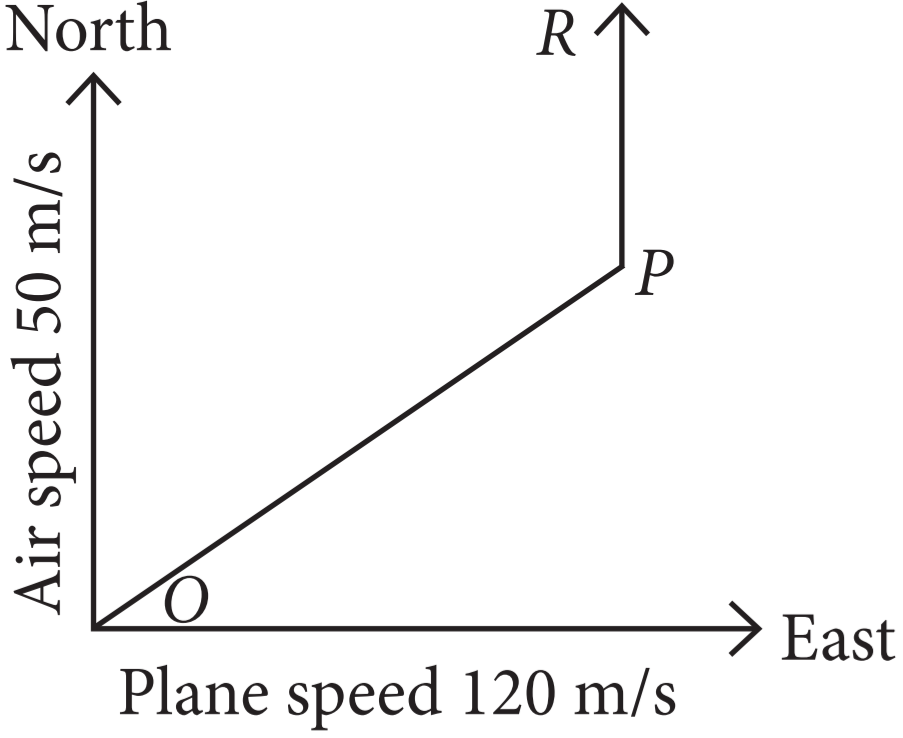
A plane started from airport situated at O with a velocity of 120m/s towards east. Air is blowing at a velocity of 50m/ s towards the north as shown in the figure.
The plane travelled 1hr in OP direction with the resultant velocity. From P to R the plane travelled 1hr keeping velocity of 120m/s and finally landed at R.

Based on the above information, answer the following questions.
  1. What is the resultant velocity from O to P?
  1. 100m/ s
  2. 130m/ s
  3. 126m/ s
  4. 180m/ s
  1. What is the direction of travel of plane from O to P with East?
  1. $\tan^{-1}\Big(\frac{5}{12}\Big)$
  2. $\tan^{-1}\Big(\frac{12}{3}\Big)$
  3. 50
  4. 80
  1. What is the displacement from O to P?
  1. 600km
  2. 468km
  3. 532km
  4. 500km
  1. What is the resultant velocity from P to R?
  1. 120m/ s
  2. 70m/ s
  3. 170m/ s
  4. 200m/ s
  1. What is the displacement from P to R?
  1. 450km
  2. 532km
  3. 610km
  4. 612km
Read the following text carefully and answer the questions that follow:
Akash and Prakash appeared for first round of an interview for two vacancies. The probability of Nisha's selection is $\frac{1}{3}$ and that of Ayushi's selection is $\frac{1}{2}$.
Image
$i.$ Find the probability that both of them are selected. $(1)$
$ii.$ The probability that none of them is selected. $(1)$
$iii.$ Find the probability that only one of them is selected.$(2)$
$OR$
Find the probability that atleast one of them is selected. $(2)$
If there is a statement involving the natural number $n$ such that:
  1. The statement is true for $n = 1$
  2. When the statement is true for $n = k ($where $k$ is some positive integer$),$ then the statement is also true for $n = k + 1.$
Then, the statement is true for all natural numbers $n.$
Also, if $A$ is a square matrix of order $n,$ then $A^2$ is defined as $AA.$ In general, $A^m = AA .... A (m$ times$).$
where $m$ is any positive integer. Based on the above information, answer the following questions.
  1. If $\text{A}=\begin{bmatrix}3&-4\\1&-1\end{bmatrix},$ then for any positive integer $n,$
  1. $\text{A}^\text{n}=\begin{bmatrix}3\text{n}&-4\text{n}\\\text{n}&-\text{n}\end{bmatrix}$
  2. $\text{A}^\text{n}=\begin{bmatrix}1+2\text{n}&-4\text{n}\\\text{n}&1-2\text{n}\end{bmatrix}$
  3. $\text{A}^\text{n}=\begin{bmatrix}3\text{n}&-8\text{n}\\1&-\text{n}\end{bmatrix}$
  4. $\text{A}^\text{n}=\begin{bmatrix}1+3\text{n}&-4\text{n}\\\text{n}&1-3\text{n}\end{bmatrix}$
  1. If $\text{A}=\begin{bmatrix}1&2\\0&1\end{bmatrix},$ then $|A^n|,$ where $\text{n}\epsilon\text{ N},$ is equal to:
  1. $2^n$
  2. $3^n$
  3. $n$
  4. $1$
  1. If $\text{A}=\begin{bmatrix}1&0\\1&1\end{bmatrix}$ and $\text{I}=\begin{bmatrix}1&0\\0&1\end{bmatrix}$ then which of the following holds for all natural numbers $\text{n}\geq1?$
  1. $A^{n }= nA - (n - 1)I$
  2. $A^n = 2^{n-1} A - (n - 1)I$
  3. $A^{n }= nA + (n - 1)I$
  4. $A^n = 2^{n-1} A + (n - 1)I$
  1. Let $\text{A}=\begin{bmatrix}\text{a}&0&0\\0&\text{a}&0\\0&0&\text{a}\end{bmatrix}$ and $\text{A}^\text{n}=[\text{a}_{\text{ij}}]_{3\times3}$ for some positive integer $n,$ then the cofactor of $a_{13}$ is:
  1. $a^n$
  2. $-a^n$
  3. $2a^n$
  4. $0$
  1. If $A$ is a square matrix such that $|A| = 2,$ then for any positive integer $n, |A^n|$ is equal to:
  1. $0$
  2. $2n$
  3. $2^n$
  4. $n^2$