MCQ
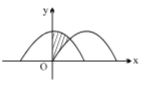
A function $y = f (x)$ satisfies the differential equation $\frac{{dy}}{{dx}} - y = \cos x - \sin x$ with initial condition that $y$ is bounded when $x \rightarrow \infty .$ The area enclosed by $y = f (x), y = \cos x$ and the $y-$ axis is
  • $\sqrt 2 \; - \;1$
  • B
    $\sqrt 2$
  • C
    $1$
  • D
    $\frac{1}{{\sqrt 2 }}$

Answer

Correct option: A.
$\sqrt 2 \; - \;1$
a
$I.F. = e^{-x}$
$ye^{-x} = \int {{e^{ - x}}(\cos x - \sin x)\,dx} $  put $- x = t$ 
$= - \int {{e^t}(\cos t + \sin t)\,dt} $ 
$= - e^t sin t + c$ 
$y e^{-x} = e^{-x} sin x + c$ 
since $y$ is bounded when $x \rightarrow \infty \Rightarrow c = 0$ 
$y = \sin x$ 
Area $= \int\limits_0^{\frac{\pi }{4}} {(\cos x - \sin x)\,dx} = \sqrt 2 \; - \;1$

Need a full question paper?

Generate a complete, print-ready paper with questions like this in minutes — across 16+ boards, with answer keys.

Start Generating Free

Similar questions

Let A = {1, 2, 3} and consider the relation R = {(1, 1), (2, 2), (3, 3), (1, 2), (2, 3), (1, 3)}. Then, R is:
  1. Reflexive but not symmetric.
  2. Reflexive but not transitive.
  3. Symmetric and transitive.
  4. Neither symmetric nor transitive.
Area of the region bounded by the curve $\text{y}=\tan\text{x,}$  line $\text{x}=\frac{\pi}{4}$ and the x-axis is:
  1. $\log2\text{ sq.}\text{units}$
  2. $\frac{1}{2}\log2\text{ sq.}\text{units}$
  3. $\frac{1}{3}\log2\text{ sq.}\text{units}$
  4. $5\log2\text{ sq.}\text{units}$
$\frac{{{d^3}y}}{{d{x^3}}} + 2\,\left[ {1 + \frac{{{d^2}y}}{{d{x^2}}}} \right] = 1$ has degree and order as
The length of the perpendicular drawn from the point $(5, 4, -1)$ on the line $\frac{{x - 1}}{2} = \frac{y}{9} = \frac{z}{5}$ is
If $y(\theta)=\frac{2 \cos \theta+\cos 2 \theta}{\cos 3 \theta+4 \cos 2 \theta+5 \cos \theta+2}$ then at $\theta=\frac{\pi}{2}, y^{\prime \prime}+y^{\prime}+y$ is equal to:
Area bounded by the curve y = x3, the x-axis and the ordinates x = -2 and x = 1 is:
  1. $-9$
  2. $\frac{-15}{4}$
  3. $\frac{15}{4}$
  4. $\frac{17}{4}$
Match the statements in column-$I$ with those in column-$II$.
column-$I$ column-$II$
$(A)$ A line from the origin meets the lines $\frac{x-2}{1}=\frac{y-1}{-2}=\frac{z+1}{1}$ and $\frac{x-\frac{8}{3}}{2}=\frac{y+3}{-1}=\frac{z-1}{1}$ at $P$ and $Q$ respectively. If length $P Q=d$, then $d^2$ is $(p)$ $-4$
$(B)$ The values of $x$ satisfying $\tan ^{-1}(x+3)-\tan ^{-1}(x-3)=\sin ^{-1}\left(\frac{3}{5}\right)$ are $(q)$ $0$
$(C)$ Non-zero vectors $\vec{a}, \vec{b}$ and $\overrightarrow{\mathrm{c}}$ satisfy $\vec{a} \cdot \vec{b}=0$, $(\vec{b}-\vec{a}) \cdot(\vec{b}+\vec{c})=0$ and $2|\vec{b}+\vec{c}|=|\vec{b}-\vec{a}|$. If $\vec{a}=\mu \vec{b}+4 \vec{c}$, then the possible values of $\mu$ are $(r)$ $4$
$(D)$ Let $f$ be the function on $[-\pi, \pi]$ given by $f(0)=9$ and $f(x)=$ $\sin \left(\frac{9 x}{2}\right) / \sin \left(\frac{x}{2}\right)$ for $x \neq 0$. The value of $\frac{2}{\pi} \int_{-\pi}^\pi f(x) d x$ is $(s)$ $5$
  $(t)$ $6$
Let $f : [0,1] \to [0,1]$ be a continuous function, then the equation $f(x) = x$
The value of $\cot \left(\sum_{n=1}^{23} \cot ^{-1}\left(1+\sum_{k=1}^n 2 k\right)\right)$ is
$\int_{}^{} {\frac{1}{{1 + {{\sin }^2}x}}\;dx = } $