MCQ
$\mathrm{A}_{(\mathrm{g})} \rightleftharpoons \mathrm{B}_{(\mathrm{g})}+\frac{\mathrm{C}}{2}(\mathrm{~g}) \quad$ The correct relationship between $K_P, \alpha$ and equilibrium pressure $P$ is
  • A
    $K_P=\frac{\alpha^{1 /_2} P^{1 / 2}}{(2+\alpha)^{1 /_2}}$
  • $K_P=\frac{\alpha^{3 /_2} P^{1 / 2}}{(2+\alpha)^{1 / 2}(1-\alpha)}$
  • C
    $K_P=\frac{\alpha^{1 /_2} P^{3 / 2}}{(2+\alpha)^{3 /_2}}$
  • D
    $K_P=\frac{\alpha^{1 /_2} P^{1 / 2}}{(2+\alpha)^{3 /_2}}$
Answer

Correct option: B.
$K_P=\frac{\alpha^{3 /_2} P^{1 / 2}}{(2+\alpha)^{1 / 2}(1-\alpha)}$
b
$A_{(g)} \rightleftharpoons B_{(g)}+\frac{C}{2}(g)$

$t=t_{e q}(1-\alpha) \quad \alpha \quad \frac{\alpha}{2}$

$\mathrm{P}_{\mathrm{B}}=\frac{\alpha}{\left(1+\frac{\alpha}{2}\right)} . \mathrm{P}, \mathrm{P}_{\mathrm{A}}=\frac{(1-\alpha)}{\left(1+\frac{\alpha}{2}\right)} \cdot \mathrm{P}, \mathrm{P}_{\mathrm{C}}=\frac{\frac{\alpha}{2}}{\left(1+\frac{\alpha}{2}\right)} \cdot \mathrm{P}$

$K_P=\frac{P_B \cdot P_C^{\frac{1}{2}}}{P_A}$

$=\frac{(\alpha)^{\frac{3}{2}}(P)^{\frac{1}{2}}}{(1-\alpha)(2+\alpha)^{\frac{1}{2}}}$

Need a full question paper?

Generate a complete, print-ready paper with questions like this in minutes — across 16+ boards, with answer keys.

Start Generating Free

Similar questions

A carbon-carbon triple bond in ethyne $( - C \equiv C - )$ consists of
Choose the correct order for the given properties
Which of the following order is correct for the property mentioned in brackets ?
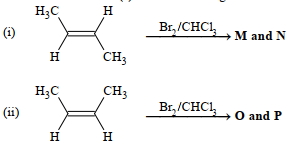
The correct statement(s) for the following addition reactions is(are)

(IMAGE)

$[A]$ ( $M$ and $O)$ and ( $N$ and $P$ ) are two pairs of diastereomers

$[B]$ Bromination proceeds through trans-addition in both the reactions

$[C]$ $O$ and $P$ are identical molecules

$[D]$ (M and $O)$ and ( $N$ and $P)$ are two pairs of enantiomers

Match the thermodynamic processes given under Column $I$ with the expression given under Column $II$:
Column $I$ Column $II$
$(A)$ Freezing of water at $273 K$ and $1 \ atm$ $(P)$ $q =0$
$(B)$ Expansion of $1 \ mol$ of an ideal gas into a vacuum under isolated conditions $(Q)$ $w=0$
$(C)$ Mixing of equal volumes of two ideal gases at constant temperature and pressure in an isolated container $(R)$ $\Delta S _{\text {sy5 }} < 0$
$(D)$ Reversible heating of $H _2( g )$ at $1 \ atm$ from $300 \ K$ to $600 \ K$, followed by reversible cooling to $300 \ K$ at $1 \ atm$ $(S)$ $\Delta U =0$
  $(T)$ $\Delta G =0$
$NaOH$ is a strong base because
Cairo's acid have how many $S-OH$ bond
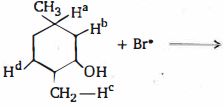
$Br^\bullet $ will abstract which of the hydrogen most readily ?
Which of the following alkenes gives only acetic acid and on oxidation with potassium permanganate solution
$\Delta {H^o}$ combustion of $C_4H_{10}(g)$ is $-2650\, kJ\, mol^{-1}$ the amount of heat evolve at constant pressure that can be obtained by burning $5.8\, kg$ of $C_4H_{10}$ is approx