Question
A galvanometer can be converted into an ammeter by connecting(a) Low resistance in series(b) High resistance in parallel(c) Low resistance in parallel(d) High resistance in series


Answer

(c) Low resistance in parallel

Need a full question paper?

Generate a complete, print-ready paper with questions like this in minutes — across 16+ boards, with answer keys.
Start Generating Free

Similar questions

A nonzero external force acts on a system of particles. The velocity and the acceleration of the centre of mass are found to be $v_0$ and $a_0$ at instant $t.$ It is possible that:
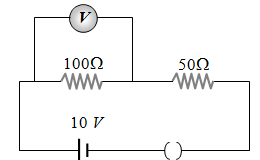
In the given circuit, the voltmeter records $5$ volts. The resistance of the voltmeter in ohms is
A vertical wire carries a current in upward direction. An electron beam sent horizontally towards the wire will be deflected:
  1. Towards right.
  2. Towards left.
  3. Upwards.
  4. Downwards.
An object is at a distance of 0.5 m in front of a plane mirror. Distance between the object and image is(a) 0.5 m                                            (b) 1 m(c) 0.25 m(d) 1.5 m
       
The condensers of capacity $C_1$ and $C_2$ are connected in parallel, then the equivalent capacitance is
Fraunhofer lines of the solar system is an example of(a) Emission spectrum(b) Emission band spectrum(c) Continuous emission spectrum(d) Line absorption spectrum
   
   
A charge produces an electric field of $1\ N/C$ at a point distant $0.1 m$ from it. The magnitude of charge is
The capacity of a parallel plate condenser is 10μF  without dielectric. Dielectric of constant 2 is used to fill half the distance between the plates, the new capacitance in μF is(a) 10(b) 20(c) 15       (d) 13.33
       
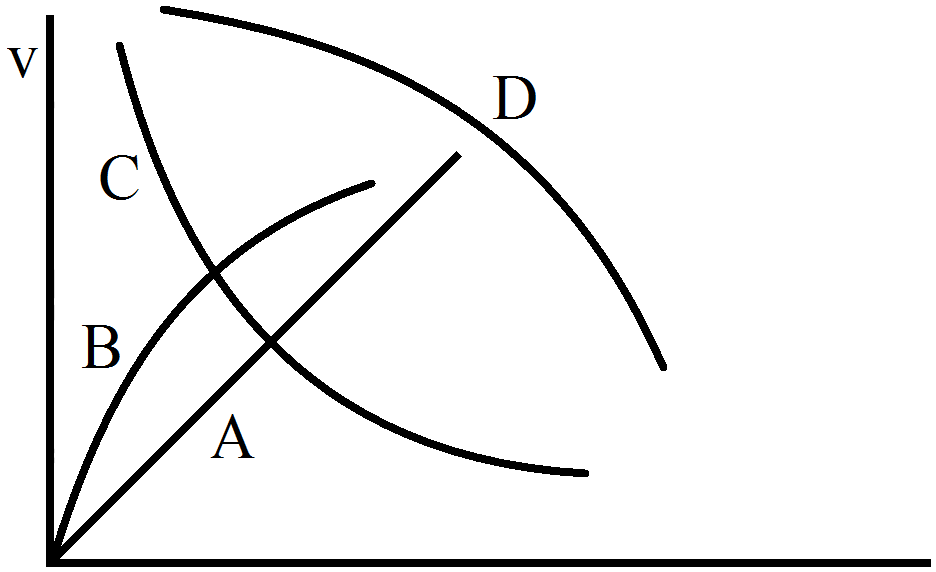
A spherical ball is dropped in a long column of a viscous liquid. The speed of the ball as a function of time may be best represented by the graph:
  1. A
  2. B
  3. C
  4. D
Let r be the distance of a point on the axis of a magnetic dipole from its centre. The magnetic field at such a point is proportional to:
  1. $\frac{1}{\text{r}}$
  2. $\frac{1}{\text{r}^2}$
  3. $\frac{1}{\text{r}^3}$
  4. None of these.