A galvanometer of resistance $100\,\Omega $ has $50\, divisions$ on its scale and has sensitivity of $20\,\mu A / division$. It is to be converted to a voltmeter with three ranges, of $0-2\, V$, $0-10\, V$ and $0-20\, V$. The appropriate circuit to do so is
- A
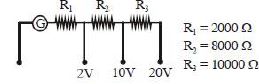
- B
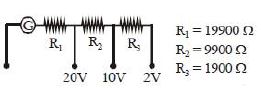
- C
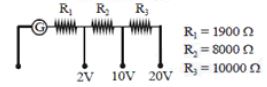
- D
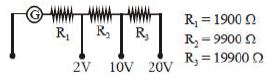
JEE MAIN 2019, Diffcult


Download our appand get started for free
Experience the future of education. Simply download our apps or reach out to us for more information. Let's shape the future of learning together!No signup needed.*
Similar Questions
- 1View SolutionA current carrying wire in the neighborhood produces
- 2View SolutionTwo free parallel wires carrying currents in opposite direction
- 3In given figure, $X$ and $Y$ are two long straight parallel conductors each carrying a current of $2\,\, A.$ The force on each conductor is $F$ newtons. When the current in each is changed to $1\, A $ and reversed in direction, the force on each is nowView Solution

- 4Two identical conducting wires $AOB$ and $COD$ are placed at right angles to each other. The wire $AOB$ carries an electric current $I_1$ and $COD$ carries a current $I_2$ . The magnetic field on a point lying at a distance $d$ from $O$, in a direction perpendicular to the plane of the wires $AOB$ and $COD$, will be given byView Solution
- 5A particle having charge of $1 \,\,C$, mass $1 \,\,kg$ and speed $1 \,\,m/s$ enters a uniform magnetic field, having magnetic induction of $1$ $T,$ at an angle $\theta = 30^o$ between velocity vector and magnetic induction. The pitch of its helical path is (in meters)View Solution
- 6View SolutionThe time period of a charged particle undergoing a circular motion in a uniform magnetic field is independent of its
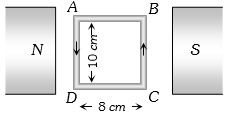
- 7A $100$ $turns$ coil shown in figure carries a current of $2\, amp$ in a magnetic field $B = 0.2\,Wb/{m^2}$. The torque acting on the coil isView Solution
- 8A wire in the form of a square of side ‘$a$’ carries a current $i$. Then the magnetic induction at the centre of the square wire is (Magnetic permeability of free space =${\mu _o}$)View Solution
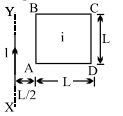
- 9A square loop $ABCD$, carrying a current $i,$ is placed near and coplanar with a long straight conductor $XY$ carrying a current $I,$ the net force on the loop will beView Solution
- 10A $2\, MeV$ proton is moving perpendicular to a uniform magnetic field of $2.5\, tesla$. The force on the proton isView Solution