MCQ
A gas at initial temperature $T$ undergoes sudden expansion from volume $V$ to $2 \,V$. Then,
  • the process is adiabatic
  • B
    the process is isothermal
  • C
    the work done in this process is $n R T \ln _{e}(2)$, where $n$ is the number of moles of the gas
  • D
    the entropy in the process does not change
Answer

Correct option: A.
the process is adiabatic
a
$(a)$ In sudden expansion, time duration is small. Thus, heat does not leave or enter the gas mass.

Process of sudden expansion is adiabatic process, $\Delta Q=0$

Need a full question paper?

Generate a complete, print-ready paper with questions like this in minutes — across 16+ boards, with answer keys.

Start Generating Free

Similar questions

Let $\overrightarrow{\text{C}}=\overrightarrow{\text{A}}+\overrightarrow{\text{B}}.$
  1. $|\overrightarrow{\text{C}}|$ is always greater than $|\overrightarrow{\text{A}}|$
  2. It is possible to have $|\overrightarrow{\text{C}}|<|\overrightarrow{\text{A}}|$ and $|\overrightarrow{\text{C}}|<|\overrightarrow{\text{B}}|$
  3. C is always equal to A + B
  4. C is never equal to A + B.
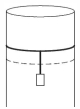
A long cylindrical pipe of radius $20 \,cm$ is closed at its upper end and has an airtight piston of negligible mass as shown. When a $50 \,kg$ mass is attached to the other end of the piston, it moves down. If the air in the enclosure is cooled from temperature $T$ to $T-\Delta T$, the piston moves back to its original position. Then $\Delta T / T$ is close to (Assuming air to be an ideal gas, $g=10 \,m / s ^2$, atmospheric pressure is $10^5 \,Pa$ )
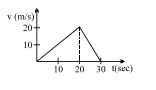
$v-t$ graph of an object of mass $1\,\, kg$ is shown
For a simple pendulum, a graph is plotted between its kinetic energy $(KE)$ and potential energy $(PE)$ against its displacement $d$. Which one of the following represents these correctly? (graphs are schematic and not drawn to scale)
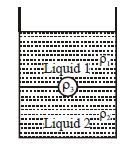
Diagram shows a jar filled with two non mixing liquids $1$ and $2$ having densities ${\rho _1}$ and  ${\rho _2}$  respectively. A solid ball, made of a material of density  ${\rho _3}$ , is dropped in the jar. It comes to equilibrium in the position shown in the figure. Which of the following is true for ${\rho _1}$ ,  ${\rho _2}$ and ${\rho _3}$  ?
A marble block of mass $2\, kg$ lying on ice when given a velocity of $6\, m/s$ is stopped by friction in $10s$. Then the coefficient of friction is-
A sample of gas with $\gamma=1.5$ is taken through an adiabatic process in which the volume is compressed from $1200\, {cm}^{3}$ to $300\, {cm}^{3}$. If the initial pressure is $200\, {kPa}$. The absolute value of the workdone by the gas in the process $= \,..... J.$
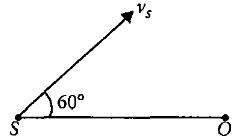
A source of sound $S$ emitting waves of frequency $100\,\, Hz$ and an observer $O$ are ocated at some distance from each other. The source is moving with a speed of $19 .4\,\, m s^{-1}$ at an angle of $60^o $ with the source observer line as shown in the figure. The observer is at rest. The apparent frequency observed by the observer .... $Hz$ (velocity of sound in air $330 \,\, m s^{-1}$), is 
The sound carried by air from a sitar to a listener is a wave of the following type
$Assertion$ : Frictional forces are conservative forces.
$Reason$ : Potential energy can be associated with frictional forces.