A gas ($\gamma = 1.3)$ is enclosed in an insulated vessel fitted with insulating piston at a pressure of ${10^5}\,N/{m^2}$. On suddenly pressing the piston the volume is reduced to half the initial volume. The final pressure of the gas is
Medium
Download our app for free and get started
(b)$\because \;P{V^\gamma } = k$(constant) ==> ${P_1}V_1^\gamma = {P_2}V_2^\gamma $
$⇒$ ${P_2} = {P_1}{\left( {\frac{{{V_1}}}{{{V_2}}}} \right)^\gamma } = {10^5} \times {(2)^{1.3}}$ $(\because \;{V_2} = \frac{{{V_1}}}{2})$
$⇒$ ${P_2} = {P_1}{\left( {\frac{{{V_1}}}{{{V_2}}}} \right)^\gamma } = {10^5} \times {(2)^{1.3}}$ $(\because \;{V_2} = \frac{{{V_1}}}{2})$

Download our appand get started for free
Experience the future of education. Simply download our apps or reach out to us for more information. Let's shape the future of learning together!No signup needed.*
Similar Questions
- 1A diatomic gas, having $C_{p}=\frac{7}{2} R$ and $C _{ v }=\frac{5}{2} R ,$ is heated at constant pressure. The ratio $dU : dQ : dW :$View Solution
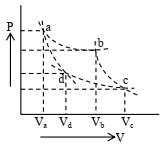
- 2Two different adiabatic paths for the same gas intersect two isothermal curves as shown in$P-V$ diagram. The relation between the ratio $\frac{V_a}{V_d}$ and the ratio $\frac{V_b}{V_c}$ is:View Solution
- 3View SolutionThe internal energy of an ideal gas depends upon
- 4The amount of work done in an adiabatic expansion from temperature $T$ to ${T_1}$ isView Solution
- 5For adiabatic processes $\left( {\gamma = \frac{{{C_p}}}{{{C_v}}}} \right)$View Solution
- 6View SolutionA reversible engine and an irreversible engine are working between the same temperatures. The efficiency of the ...........
- 7A gas expands adiabatically at constant pressure such that its temperature $T \propto \frac{1}{{\sqrt V }}$, the value of ${C_P}/{C_V}$ of gas isView Solution
- 8The efficiency of a Carnot engine operating with reservoir temperature of $100\,^{\circ} C$ and $-23\,^{\circ} C$ will beView Solution
- 9$Assertion :$ Thermodynamic process in nature are irreversible.View Solution
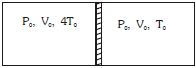
$Reason :$ Dissipative effects cannot be eliminated. - 10Figure shows a cylindrical adiabatic container of total volume $2V_0$ divided into two equal parts by a conducting piston (which is free to move). Each part containing identical gas at pressure $P_0$ . Initially temperature of left and right part is $4T_0$ and $T_0$ respectively. An external force is applied on the piston to keep the piston at rest. Find the value of external force required when thermal equilibrium is reached. ( $A =$ Area of piston)View Solution