MCQ
A gate in which all the inputs must be low to get a high output is called
  • A
     A NAND gate
  •  An inverter
  • C
    A NOR gate
  • D
     An AND gate

Answer

Correct option: B.
 An inverter
 An inverter

Need a full question paper?

Generate a complete, print-ready paper with questions like this in minutes — across 16+ boards, with answer keys.
Start Generating Free

Similar questions

Cathode rays enter into a uniform magnetic field perpendicular to the direction of the field. In the magnetic field their path will be
An unstable heavy nucleus at rest breaks into two nuclei which move away with velocities in the ratio of $8:27$. The ratio of the radii of the nuclei (assumed to be spherical ) is
In case of a bar magnet, lines of magnetic induction:
An electron with kinetic energy $E$ collides with a hydrogen atom in the ground state. The collision will be elastic
The binding energy per nucleon of deuterium and helium atom is 1.1 MeV and 7.0 MeV. If two deuterium nuclei fuse to form helium atom, the energy released is
The charge on 500 cc of water due to protons will be
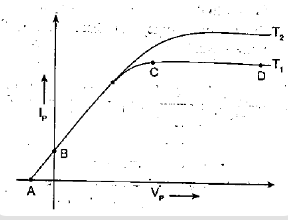
A graph of vacuum diode current $I_p$, is plotted against the anode voltage $V_p$ for two different temperatures $T_1$ and $T_2$ of the cathode, as shown in the figure below. Study the graph and answer the following questions.
For the same anode voltage, $($called plate voltage$)$, the current more when the cathode temperature changes from $T_1$ to $T_2$ higher temperature. 
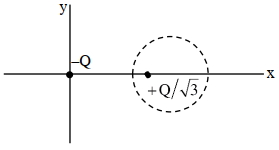
Two point charges $-Q$ and $+Q / \sqrt{3}$ are placed in the xy-plane at the origin $(0,0)$ and a point $(2,0)$, respectively, as shown in the figure. This results in an equipotential circle of radius $R$ and potential $V =0$ in the $xy$-plane with its center at $(b, 0)$. All lengths are measured in meters.

($1$) The value of $R$ is. . . . meter.

($2$) The value of $b$ is. . . . . .meter.
Hydrogen atom from excited state comes to the ground by emitting a photon of wavelength $\lambda$. The value of principal quantum number ' $n$ ' of the excited state will be:

($R$: Rydberg constant)

Assertion : Corpuscular theory fails in explaining the velocities of light in air and water.
Reason : According to corpuscular theory, light should travel faster in denser medium than, in rarer medium.