MCQ
A geostationary satellite
  • Revolves about the polar axis
  • B
    Has a time period less than that of the near earth satellite
  • C
    Moves faster than a near earth satellite
  • D
    Is stationary in the space

Answer

Correct option: A.
Revolves about the polar axis
a
A geosynchronous satellite is a satellite whose orbital track on earth repeats regularly over points on the earth over time. If such a satellites orbit lies over the equator, it is called a geostationary satellite. Hence, geostationary satellite revolves about the polar axis.

Need a full question paper?

Generate a complete, print-ready paper with questions like this in minutes — across 16+ boards, with answer keys.
Start Generating Free

Similar questions

An underwater sonar source operating at a frequency of 60 kHz directs its beam towards the surface. If the velocity of sound in air is $330 m / s$, wavelength and frequency of the waves in air are
Which of the following have same dimensions?
A mass of $10 \,gm$ is suspended by a string and the entire system is falling with a uniform acceleration of $400\,cm/{\sec ^2}.$The tension in the string will be.......... $dyne$ $(g = 980\,cm/{\sec ^2})$
A constant torque acting on a uniform circular wheel changes its angular momentum from $A_0$ to $4A_0$ in $4\, second$. The magnitude of this toque is
One mole of an ideal gas is contained with in a cylinder by a frictionless piston and is initially at temperature $T$. The pressure of the gas is kept constant while it is heated and its volume doubles. If $R$ is molar gas constant, the work done by the gas in increasing its volume is
If a particle of mass $m$ is moving in a horizontal circle of radius $r$ with a centripetal force $( - k/{r^2})$, the total energy is
A black body radiates heat energy at the rate of $2\times10^5\, J/sm^2$ at temp. of $127\,^oC$. The temp of black body at which rate becomes $32\times10^5\, J/s-m^2%$ is ....... $^oC$
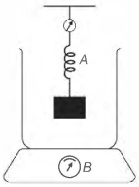
A spring balance $A$ reads $2 \,kg$ with a block of mass $m$ suspended from it. Another balance $B$ reads $3 \,kg$ when a beaker with a liquid is put on its pan. The two balances are now so arranged that the hanging mass $m$ is fully immersed inside the liquid in the beaker as shown in the figure given below.In this situation,
Molar specific heat at constant volume is ${C_v}$ for a monoatomic gas is
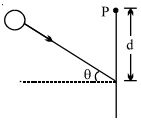
$A$ ball of mass $m$ moving with velocity $v$, collide with the wall elastically as shown in the figure.After impact the change in angular momentum about $P$ is: