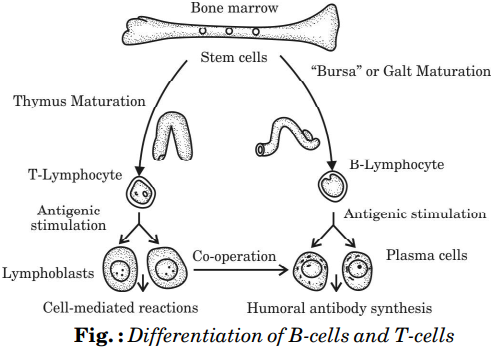
(A) Lymphocytes (type of WBCs) are main cells of immune system. The two types of Lyphoytes, meant for immune system are T-cells and B-cells. These cells develop from the stem cells found in liver of the foctus and in the bone marrow cells of the adult. Those cells that differentiate in the bone marrow are called 'B-cells'. They are called so, because they mature within the
Bursa of Fabricius in birds. While those cells that migrate to thymus and differentiate under its influence are known as 'T-cells'. These young lymphocytes finally matures in lymphoid tissues (like spleen, tonsils, lymph nodes). B-lymphocytes are independent of the thymus and in man probably complete their early maturation within the bone marrow.
T-cells are responsible for cellular immunity whereas B-cells produce the antibodies. Both T-cells and B-cells require antigens to trigger them into action but they respond differently.
Mode of Action of B-cells to Antigens : The body has thousands of antigen-specific B-cells. The membrane of each B-cell type would have been sensitized by the previous contact with the antigen. If this does not happen, the B-cells are destroyed but new cells are produced continuously. Once an antigen-specific B-cell is activated by the antigen, it multiplies very fast to form a clone of plasma cells. The plasma cells produce antibodies at very high rate (about 2,000 molecules/sec.)
Mode of Action of T-cells to Antigens : T-cells also respond to antigens by producing a clone of T-cells. There are separate T-cells for each type of antigen that invades the body. T-cells usually live for 4 - 5 years. T-cells of a clone that are produced in response of an antigen are similar morphologically but they perform different functions. According to their functions, there are three types of T-cells:
1. Helper T-cells : These cells stimulate B-cells to produce more of antibodies.
2. Killer T-cells : They directly attract and destroy antigens. These cells move to the site of invasion and produce chemicals. These chemicals attract phagocytes and stimulate them so that they can more vigrously feed on antigens. They also produce substances that attract other T-cells.
3. Suppressor T-cells : These cells suppress the whole immune system so that they may not attack their own body cells. Some of these cells also become memory cells.