Question
A given galvanometer is to be converted into (i) an ammeter (ii) a milliammeter (iii) a voltmeter. In which case will the required resistance be (i) least (ii) highest and why?

Answer

The required resistance has least value in the case of an ammeter and maximum value in the case of a voltmeter.
This is due to the reason that the shunt resistance required to convert a galvanometer into ammeter or milliammeter has the value.
$\text{S}=\frac{\text{I}_g}{\text{I}-\text{I}_\text{g}}\times\text{R}_\text{g}$
Thus, the shunt required in the case of milliammeter has higher value.
Similarly, since the voltmeter should have a high resistance, the value of required resistance should be highest in the case of a voltmeter. This is connected in series with the coil of the galvanometer.

Need a full question paper?

Generate a complete, print-ready paper with questions like this in minutes — across 16+ boards, with answer keys.
Start Generating Free

Similar questions

What is the de Broglie wavelength of:
  1. A bullet of mass 0.040 kg travelling at the speed of 1.0 km/s,
  2. A ball of mass 0.060 kg moving at a speed of 1.0 m/s, and
  3. A dust particle of mass $1.0 \times 10^{–9} kg$ drifting with a speed of 2.2 m/s?
A liquid-nitrogen container is made of a 1cm thick styrofoam sheet having thermal conductivity $0.025\text{Js}^{-1}\text{m}^{-1}{^\circ}\text{C}^{-1}.$ Liquid nitrogen at 80K is kept in it. A total area of $0.80m^2$ is in contact with the liquid nitrogen. The atmospheric temperature is 300K. Calculate the rate of heat flow from the atmosphere to the liquid nitrogen.
  1. Identify the part of the electromagnetic spectrum used in (i) radar and (ii) eye surgery. Write their frequency range.
  2. Prove that the average energy density of the oscillating electric field is equal to that of the oscillating magnetic field.
A ball of mass 0.50kg moving at a speed of 5.0m/s collides with another ball of mass 1.0kg. After the collision the balls stick together and remain motionless. What was the velocity of the 1.0kg block before the collision?
  1. Mention two properties of soft iron due to which it is preferred for making an electromagnet.
  2. State Gauss's law in magnetism. How is it different from Gauss's law in electrostatics and why?
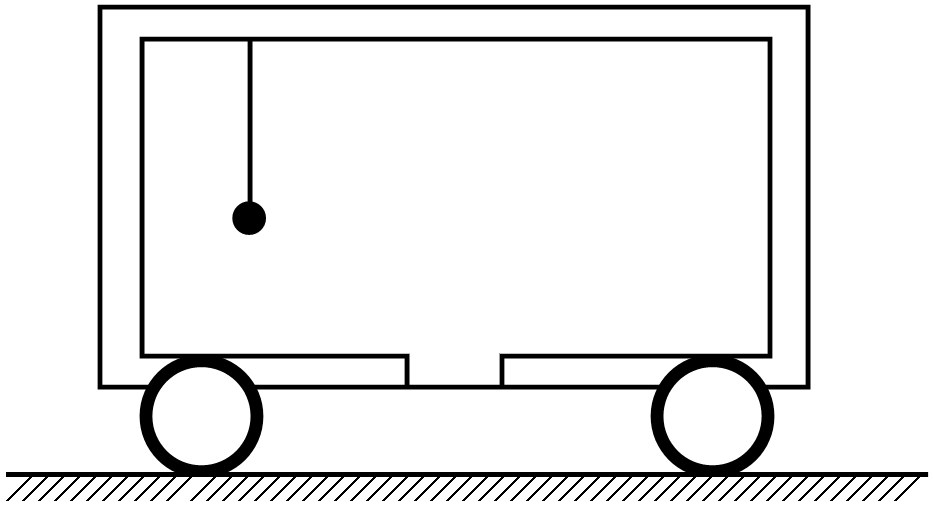
A cart of mass M is at rest on a frictionless horizontal surface and a pendulum bob of mass m hangs from the roof of the cart. The string breaks, the bob falls on the floor, makes several collisions on the floor and finally lands up in a small slot made in the floor. The horizontal distance between the string and the slot is L. Find the displacement of the cart during this process.
Can we have magnetic hysteresis in paramagnetic or diamagnetic substances?
In what way is Gauss’s law in magnetism different from that used in electrostatics? Explain briefly. The Earth’s magnetic field at the Equator is approximately 0.4 G. Estimate the Earth’s magnetic dipole moment. Given: Radius of the Earth = 6400 km.
A galvanometer coil has a resistance of 12 Ω and the metre shows full scale deflection for a current of 3 mA. How will you convert the metre into a voltmeter of range 0 to 18 V?
Consider a point at the focal point of a convergent lens. Another convergent lens of short focal length is placed on the other side. What is the nature of the wavefronts emerging from the final image?