Question
A given galvanometer is to be converted into (i) an ammeter (ii) a milliammeter (iii) a voltmeter. In which case will the required resistance be (i) least (ii) highest and why?

Answer

The required resistance has least value in the case of an ammeter and maximum value in the case of a voltmeter.
This is due to the reason that the shunt resistance required to convert a galvanometer into ammeter or milliammeter has the value.
$\text{S}=\frac{\text{I}_g}{\text{I}-\text{I}_\text{g}}\times\text{R}_\text{g}$
Thus, the shunt required in the case of milliammeter has higher value.
Similarly, since the voltmeter should have a high resistance, the value of required resistance should be highest in the case of a voltmeter. This is connected in series with the coil of the galvanometer.

Need a full question paper?

Generate a complete, print-ready paper with questions like this in minutes — across 16+ boards, with answer keys.
Start Generating Free

Similar questions

Find the charge appearing on each of the three capacitors shown in figure.

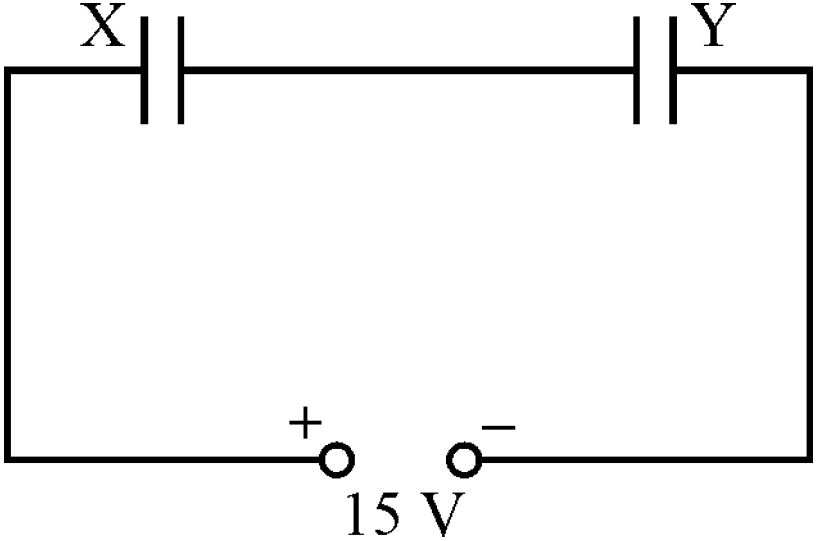
Two parallel plate capacitors X and Y have the same area of plates and same separation between them. X has air between the plates while Y contains a dielectric medium of $\varepsilon_{\text{r}} = 4.$

  1. Calculate capacitance of each capacitor if equivalent capacitance of the combination is $4\mu\text{f}.$
  2. Calculate the potential difference between the plates of X and Y.
  3. Estimate the ratio of electrostatic energy stored in X and Y.
The current through a wire depends on time as $\text{i}=\text{i}_0+\alpha\text{t},$
Where $\text{i}_0=10\text{A}$ and $\alpha=4\text{A/ s}.$ Find the charge that crosses through a section of the wire in 10 seconds.
A symmetric biconvex lens of radius of curvature R and made of glass of refractive index 1·5, is placed on a layer of liquid placed on top of a plane mirror as shown in the figure. An optical needle with its tip on the principal axis of the lens is moved along the axis until its real, inverted image coincides with the needle itself. The distance of the needle from the lens is measured to be x. On removing the liquid layer and repeating the experiment, the distance is found to be y. Obtain the expression for the refractive index of the liquid in terms of x and y.

What will be the effect on placing a metal foil between the plates of a parallel plate capacitor on its capacitance?
Three point charges +Q, -2Q and -3Q are placed at the vertices of an equilateral triangle ABC of side l.
If these charges are displaced to the mid points A1, B1 and C1 respectively, calculate the amount of work done in shifting the charges to the new locations.
In a p-n junction, a potential barrier of 250meV exists across the junction. A hole with a kinetic energy of 300meV approaches the junction. Find the kinetic energy of the hole when it crosses the junction if the hole approached the junction.
  1. From the p-side.
  2. From the n-side.
  1. A radioactive nucleus 'A' undergoes a series of decays as given below:

$\text{A}\xrightarrow\alpha\text{A}_1\xrightarrow\beta\text{A}_2\xrightarrow\alpha\text{A}_3\xrightarrow\gamma\text{A}_4$

The mass number and atomic number of A2 are 176 and 71 respectively. Determine the mass and atomic numbers of A4 and A.

  1. Write the basic nuclear process underlying $\beta+$ and $\beta-$ decays.
A man uses a concave mirror for shaving. He keeps his face at a distance of 25cm from the mirror and gets an image which is 1.4 times enlarged. Find the focal length of the mirror.
A circular loop of radius r carrying a current i is held at the centre of another circular loop of radius R(>> r) carrying a current I. The plane of the smaller loop makes an angle of 30° with that of the larger loop. If the smaller loop is held fixed in this position by applying a single force at a point on its periphery, what would be the minimum magnitude of this force?