MCQ
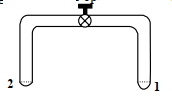
A glass tube of uniform internal radius ( $\mathrm{r}$ ) has a valve separating the two identical ends. Initially, the valve is in a tightly closed position. End $1$ has a hemispherical soap bubble of radius $\mathrm{r}$. End $2$ has sub-hemispherical soap bubble as shown in figure. Just after opening the valve,

Figure: $Image$
  • A
    air from end $1$ flows towards end $2$. No change in the volume of the soap bubbles
  • air from end $1$ flows towards end $2$. Volume of the soap bubble at end $1$ decreases
  • C
    no changes occurs
  • D
    air from end $2$ flows towards end $1$ . volume of the soap bubble at end $1$ increases
Answer

Correct option: B.
air from end $1$ flows towards end $2$. Volume of the soap bubble at end $1$ decreases
b
$P_1=$ pressure just inside the bubble at the end $2=P_0+\frac{4 T}{R}$

$\mathrm{P}_2=$ pressure just inside the bubble at the end $1=\mathrm{P}_0+\frac{4 \mathrm{~T}}{\mathrm{r}}$

$\mathrm{R}>\mathrm{I} \Rightarrow \mathrm{P}_2<\mathrm{P}_1 \Rightarrow$ Air will flow from end $1$ to end $2$

Need a full question paper?

Generate a complete, print-ready paper with questions like this in minutes — across 16+ boards, with answer keys.

Start Generating Free

Similar questions

A man carrying a monkey on his shoulder does cycling smoothly on a circular track of radius $9 \mathrm{~m}$ and completes $120$ revolutions in $3$ minutes. The magnitude of centripetal acceleration of monkey is (in $\mathrm{m} / \mathrm{s}^2$ ):
A conducting rod is moved with a constant velocity v in a magnetic field. A potential difference appears across the two ends:
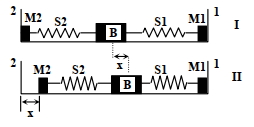
A block $(B)$ is attached to two unstretched springs $\mathrm{S} 1$ and $\mathrm{S} 2$ with spring constants $\mathrm{k}$ and $4 \mathrm{k}$, respectively (see figure $\mathrm{I}$ ). The other ends are attached to identical supports $M1$ and $M2$ not attached to the walls. The springs and supports have negligible mass. There is no friction anywhere. The block $\mathrm{B}$ is displaced towards wall $1$ by a small distance $\mathrm{x}$ (figure $II$) and released. The block returns and moves a maximum distance $\mathrm{y}$ towards wall $2$ . Displacements $\mathrm{x}$ and $\mathrm{y}$ are measured with respect to the equilibrium position of the block $B$. The ratio $\frac{y}{x}$ is Figure: $Image$
From a disc of radius $R$ and mass $M,$ a circular hole of diameter $R,$ whose rim passes through the centre is cut. What is the moment of inertia of the remaining part of the disc about a perpendicular axis, passing through the centre?
$A$ particle of mass $2\, kg$ located at the position $(\hat i + \hat j)$ $m$ has a velocity $2( + \hat i - \hat j + \hat k)m/s$. Its angular momentum about $z$ -axis in $kg-m^2/s$ is
In a rocket, fuel burns at the rate of $1\; kg/s$. This fuel is ejected from the rocket with a velocity of $60\; km/s$. This exerts a force on the rocket equal to ......... $N$
The limiting friction between two bodies in contact is independent of
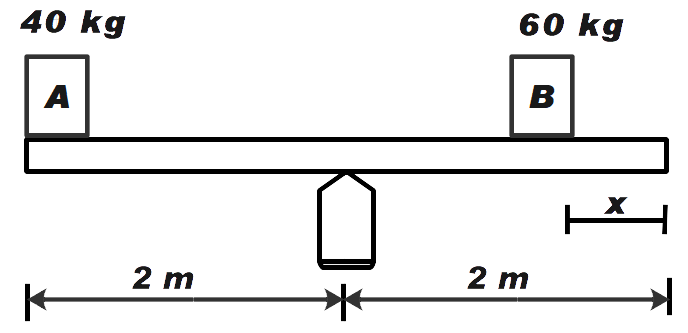
In the game of see$-$saw, what should be the displacement of boy $B$ from right edge to keep the see$-$saw in equilibrium? $(M = 40\ kg, M_2 = 60\ kg.)$
Image
A dancer on ice spins faster when she folds her arms. This is due to:
Mass is distributed uniformly over a thin rectangular plate and positions of two vertices are given by $(1, 3)$ and $(2, -4)$. What is the position of $3^{rd}$ vertex if centre of mass of the plate lies at the origin ?