MCQ
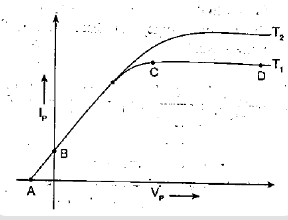
A graph of vacuum diode current Ip​, is plotted against the anode voltage Vp​ for two different temperatures T1​ and T2​ of the cathode, as shown in the figure below. Study the graph and answer the following questions.
For the same anode voltage, (called plate voltage), the current more when the cathode temperature changes from T1​ to T2​ higher temperature.

  • A
    More number of electron undergo collision
  • B
    More electrons are emitted
  • C
    Resistance increases
  • D
    Voltage increases

Answer

  1. More electrons are emitted

Need a full question paper?

Generate a complete, print-ready paper with questions like this in minutes — across 16+ boards, with answer keys.

Start Generating Free

Similar questions

The alloys constantan and manganin are used to make standard resistance due to they have

(a) Low resistivity

(b) High resistivity

(c) Low temperature coefficient of resistance

(d) Both (b) and (c)

Calculate the de-Brogile wavelength of an electron travelling at 1% of the speed of light:
Kirchoff's first law, i.e., $\sum\text{i}=0$ at a junction, deals with the conservation of:

In Milikan’s experiment, an oil drop having charge q gets stationary on applying a potential difference V in between two plates separated by a distance ‘d’. The weight of the drop is

(a) qVd

(b) q  

(c)  

(d) q 

Field inside a solenoid is

(a) Directly proportional to its length

(b) Directly proportional to current

(c) Inversely proportional to total number of turns

(d) Inversely proportional to current

In which of the following transitions will the wavelength be minimum?
  1. n = 5 to n = 4
  2. n = 4 to n = 3
  3. n = 3 to n = 2
  4. n = 2 to n = 1
A person standing near the edge of the top of a building throws two balls A and B. The ball A is thrown vertically upward and B is thrown vertically downward with the same speed. The ball A hits the ground with a speed vA and the ball B hits the ground with a speed vB. We have:
  1. vA > vB
  2. vA < vB
  3. vA = vB
  4. The relation between vand vB depends on height of the building above the ground.
P-N diode is :

You are given three bulbs of 25, 40 and 60 watt. Which of them has lowest resistance

(a) 25 watt bulb

(b) 40 watt bulb

(c) 60 watt bulb

(d) Information is insufficient

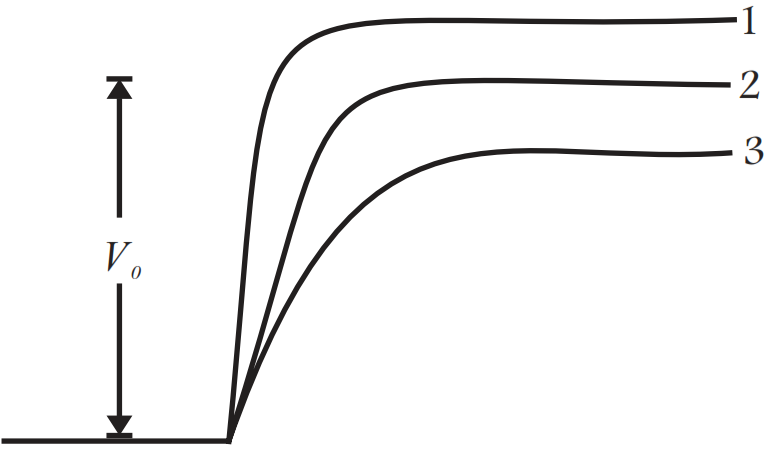
In Fig, Vo is the potential barrier across a p-n junction, when no battery is connected across the junction: