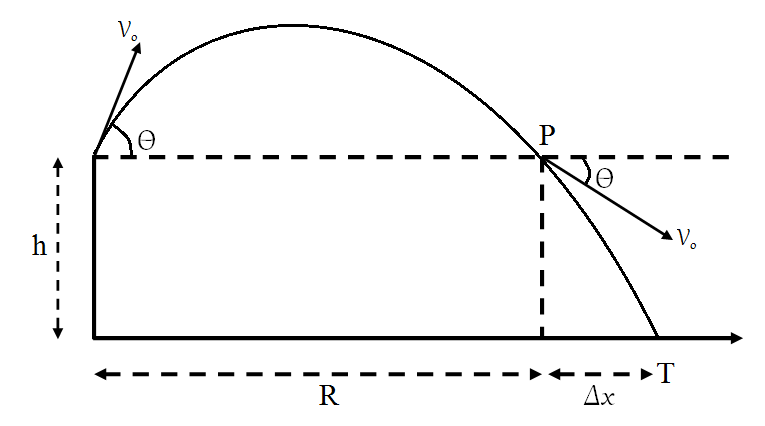
The main concept used: This problem can be solved in two different ways:
- The target is at horizontal distance $(\text{R}+\Delta\text{x})$ and below the point of projection h metre below i.e., y = -h.
- The motion of projectile after point P to T: projection speed is at an angle$(-\theta)$ i.e., $\theta^\circ$ below horizontal and vertical height covered it is (-h) and horizontal range $\Delta\text{x}.$
Solution:
$\text{R}=\frac{\text{v}^2_0}{\text{g}}\ \dots(\text{i})$ that it is maximum range of projectile
$\therefore$ The angle of projection $\theta=45^\circ$
Let the gun is raised to a heighth from the horizontal level of target T. So that the projectile can hit the target T.
Total range of projectile must be $=(\text{R}+\Delta\text{x})$
Horizontal component of velocity at $\text{A}=\text{v}_0\cos\theta$
The motion of the projectile from P to T: As A and P are on the same level. So the magnitude of velocity will be same at A and P.
$\therefore$ But the direction of velocity will be below horizontal,
so horizontal velocity at $\text{P}=\text{v}_\text{x}=-\text{v}_0\cos\theta$
So vertical velocity at $\text{P}=\text{v}_\text{y}=\text{v}_0\sin\theta$
$\text{h}=\text{ut}+\frac{1}2\text{at}^2$
$\text{h}=-\text{v}_0\sin\theta(\text{t})+\frac{1}2\text{gt}^2\ \dots(\text{ii})$
Consider horizontal motion from A to T = distance $(\text{R}+\Delta\text{x})=\text{v}_0\cos\theta.\text{t}$
$\text{t}=\frac{\text{R}+\Delta\text{x}}{\text{v}_0\cos\theta}$
Substitue t in (ii) $\text{h}=-\text{v}_02\sin\theta\Big[\frac{\text{R}+\Delta\text{x}}{\text{v}_0\cos\theta}\Big]+\frac{1}2\text{g}\frac{(\text{R}+\Delta\text{x})^2}{\text{v}^2_0\cos^2\theta}$
$\text{h}=-\tan\theta(\text{R}+\Delta\text{x})+\frac{1}2\Big(\frac{\text{g}}{\text{v}^2_0}\Big)\frac{(\text{R}+\Delta\text{x})^2}{\frac{1}2}\theta=45^\circ$
$\text{h}=-(\text{R}+\Delta\text{x})+\frac{1}{\text{R}}(\text{R}^2+\Delta\text{x}^2+2\text{R}\Delta\text{x})$ $\Big[\because\frac{\text{g}}{\text{v}^2_0}=\frac{1}{\text{R}}\Big]$
$=-\text{R}-\Delta\text{x}+\text{R}+\frac{\Delta\text{x}^2}{\text{R}}+2\Delta\text{x}=\Delta\text{x}+\frac{\Delta\text{x}^2}{\text{R}}$
$\text{h}=\Delta\text{x}\Big[1+\frac{\Delta\text{x}}{\text{R}}\Big]$ Hence proved.