MCQ
A heavy brass sphere is hung from a spring and it executes vertical vibrations with period $T.$ The sphere is now immersed in a non$-$viscous liquid with a density $(\frac{1}{10})^\text{th}$ that of brass. When set into vertical vibrations with the sphere remaining inside liquid all the time, the time period will be:
  • A
    $\sqrt{\frac{9}{10\text{T}}}$
  • $\sqrt{\frac{10}{9\text{T}}}$
  • C
    $\sqrt{\Big(\frac{9}{10}}\Big)\text{T}$
  • D
    Unchanged

Answer

Correct option: B.
$\sqrt{\frac{10}{9\text{T}}}$

Need a full question paper?

Generate a complete, print-ready paper with questions like this in minutes — across 16+ boards, with answer keys.

Start Generating Free

Similar questions

Which one of the following is dimensionless physical quantity?
Mark the correct options:
A particle starting from rest, moves in a circle of radius $r$. It attains a velocity of $\mathrm{V}_{0} \;\mathrm{m} / \mathrm{s}$ in the $\mathrm{n}^{\text {th }}$ round. Its angular acceleration will be
The correct figure that shows, schematically, the wave pattern produced by superposition of two waves of frequencies $9\,Hz$ and $11\,Hz,$
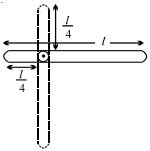
For the pivoted slender rod of length $l$ as shown in figure, the angular velocity as the bar reaches the vertical position after being released in the horizontal position is
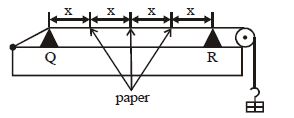
The given diagram shows three light pieces of paper placed on a wire that is stretched over two supports, $Q$ and $R$ , a distance $4x$ apart. When the wire is made to vibrate at a particular frequency, all the pieces of paper, except the middle one, fall off the wire. Which of the following could be the wavelength of the vibration?
$Y = A \sin \left(\omega t +\phi_{0}\right)$ is the time-displacement equation of a SHM. At $t=0$ the displacement of the particle is $Y =\frac{ A }{2}$ and it is moving along negative $x$ -direction. Then the initial phase angle $\phi_{0}$ will be ...... .
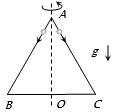
An equilateral triangle $ABC$ formed from a uniform wire has two small identical beads initially located at $A$.  The triangle is set rotating about the vertical axis $AO$.  Then the beads are released from rest simultaneously and allowed to slide down, one along $AB$ and the other along $AC$ as shown.  Neglecting frictional effects, the quantities that are conserved as the beads slide down, are
A disc of radius $1\,m$ and mass $4\,kg$ rolls on a horizontal plane without slipping in such a way that its centre of mass moves with a speed of $10\,cm/\sec .$ Its rotational kinetic energy is
Two bodies of masses ${m_1}$ and ${m_2}$ have equal kinetic energies. If ${p_1}$ and ${p_2}$ are their respective momentum, then ratio ${p_1}:{p_2}$ is equal to