Question
A heavy nucleus breaks into comparatively lighter nuclei, which are more stable compared to the original heavy nucleus. When a heavy nucleus like uranium is bombarded by slow moving neutrons, it splits into two parts, releasing large amount of energy. The typical fission reaction of $_{92}\text{U}^{235}$.
$_{92}\text{U}^{235}+\ _0\text{n}^1\rightarrow\ _{56}\text{Ba}^{141}+\ _{36}\text{kr}^{92}+\ 3_0\text{n}^1+\ 200\text{ MeV}$
The fission of $_{92}\text{U}^{235}$ approximately released 200 MeV of energy.
  1. If 200 MeV energy is released in the fission of a single nucleus of $_{92}^{235}\text{U}$, the fissions which are required to produce a power of 1kW is.
  1. $3.125 \times 10^{13}$
  2. $1.52 \times 10^6$
  3. $3.125 \times 10^{12}$
  4. $3.125 \times 10^{14}$
  1. The release in energy in nuclear fission is consistent with the fact that uranium has
  1. More mass per nucleon than either of the two fragments.
  2. More mass per nucleon as the two fragment.
  3. Exactly the same mass per nucleon as the two fragments.
  4. Less mass per nucleon than either of two fragments.
  1. When $_{92}\text{U}^{235}$ undergoes fission, about 0.1% of the original mass is converted into energy. The energy released when 1kg of $_{92}\text{U}^{235}$ undergoes fission is.
  1. $9 \times 10^{11}J$
  2. $9 \times 10^{13}J$
  3. $9 \times 10^{15}J$
  4. $9 \times 10^{18}J$
  1. A nuclear fission is said to be critical when multiplication factor or K.
  1. $K = 1$
  2. $K > 1$
  3. $K < 1$
  4. $K = 0$
  1. Einstein's mass-energy conversion relation $E = mc^2$ is illustrated by.
  1. Nuclear fission
  2. $\beta-\text{decay}$
  3. Rocket propulsion
  4. Steam engine

Answer

  1. (a) $3.125 \times 10^{13}$
Explanation:
Let the number of fissions per second be n. Energy released per second
$= n \times 200MeV = n \times 200 \times 1.6 \times 10^{-13}J$
Energy required per second = power × time
$= 1kW × Is = 1000J$
$n \times 200 \times 1.6 \times 10^{-13} = 1000$ or
$\text{n}=\frac{1000}{3.2\times10^{-11}}$
$=\frac{10}{3.2}\times10^{13}=3.125\times10^{13}$
  1. (a) More mass per nucleon than either of the two fragments.
  2. (b) $9 \times 10^{13}J$
Explanation:
As only 0.1% of the original mass is converted into energy, hence out of 1kg mass 1g is converted into energy.
Energy released during fission $\text{E}=\triangle\text{mc}^2$
$= 1g \times (3 \times 10^8 m s^{-1})^2 = 10^{-3} \times 9 \times 10^{16}J = 9 \times 10^{13}J$
  1. (a) K = 1
  2. (a) Nuclear fission

Need a full question paper?

Generate a complete, print-ready paper with questions like this in minutes — across 16+ boards, with answer keys.

Start Generating Free

Similar questions

A metallic loop is placed in a nonuniform magnetic field. Will an emf be induced in the loop?
The moon rotates about the earth in such a way that only one hemisphere of the moon faces the earth. Can we ever see the ''other face'' of the moon from the earth? Can a person on the moon ever see all the faces of the earth?
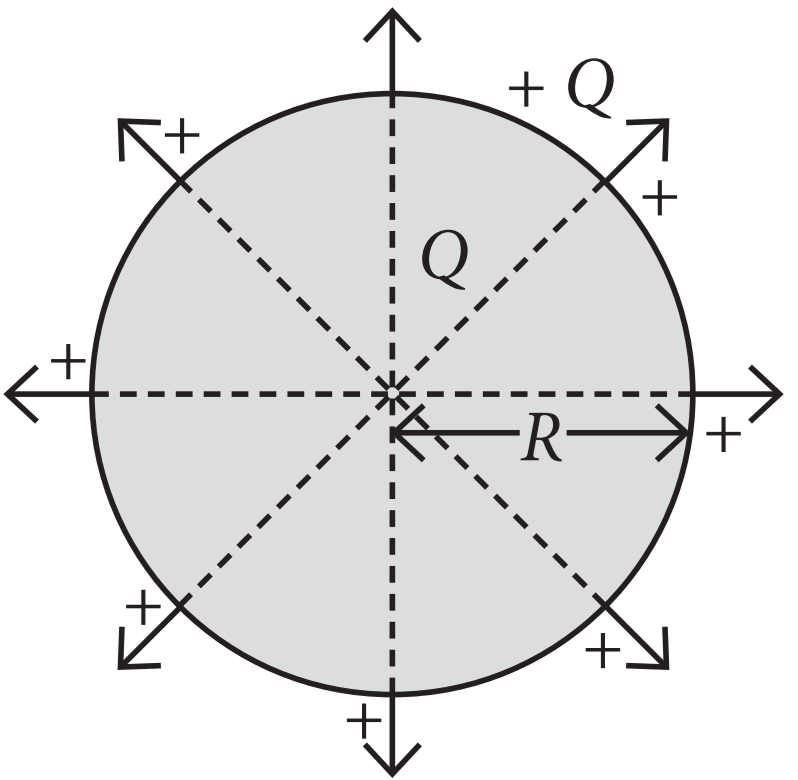
The electrical capacitance of a conductor is the measure of its ability to hold electric charge. An isolated spherical conductor of radius R. The charge Q is uniformly distributed over its entire surface. It can be assumed to be concentrated at the centre of the sphere. The potential at any point on the surface of the spherical conductor will be $\text{V}=\frac{1}{4\pi\in_0}\frac{\text{Q}}{\text{R}}.$

Capacitance of the spherical conductor situated in vacuum is $\text{C}=\frac{\text{Q}}{\text{V}}=\frac{\text{Q}}{\frac{1}{4\pi\in_0}.\frac{\text{Q}}{\text{R}}}$ or $\text{C}=4\pi\in_0\text{R}$ Clearly, the capacitance of a spherical conductor is proportional to its radius. The radius of the spherical conductor of 1F capacitance is $\text{R}=\frac{1}{4\pi\in_0}.$ C and this radius is about 1500 times the radius of the earth $(\sim6\times10^3\text{km}).$
  1. If an isolated sphere has a capacitance 50pE Then radius is:
  1. 90cm
  2. 45cm
  3. 45m
  4. 90m
  1. How much charge should be placed on a capacitance of 25 pF to raise its potential to 105V?
  1. $1\mu\text{C}$
  2. $1.5\mu\text{C}$
  3. $2\mu\text{C}$
  4. $2.5\mu\text{C}$
  1. Dimensions of capacitance is:
  1. $[M L^{-2} T^4 A^2]$
  2. $[M^{-1} L^{-1} T^3 A^1]$
  3. $[M^-L^{-2} T^4 A^2]$
  4. $[M^0 L^{-2} T^4 A^1]$
  1. Metallic sphere of radius R is charged to potential V. Then charge q is proportional to:
  1. V
  2. R
  3. Both V and R
  4. None of these
  1. If 64 identical spheres of charge q and capacitance C each are combined to form a large sphere. The charge and capacitance of the large sphere is:
  1. 64q, C
  2. 16q, 4C
  3. 64q, 4C
  4. 16q, 64C
P-n junction is a single crystal of Ge or Si doped in such a manner that one half portion of it acts asp-type semiconductor and other half functions as n-type semiconductor. As soon as a p-n junction is formed, the holes from the p-region diffuse into then-region, and electron from n region diffuse in top-region. This results in the development of V 8 across the junction which opposes the further diffusion of electrons and holes through the junction.
  1. In an unbiased p-n junction electrons diffuse from n-region top-region because:
  1. Holes in p-region attract them.
  2. Electrons travel across the junction due to potential difference.
  3. Electron concentration inn-region is more as compared to that in p-region.
  4. Only electrons move from n top region and not the vice-versa.
  1. Electron hole recombination in p-n junction may lead to emission of:
  1. Light.
  2. Ultraviolet rays.
  3. Sound.
  4. Radioactive rays.
  1. In an unbiased p-n junction:
  1. Potential at pis equal to that at n.
  2. Potential at pis + ve and that at n is - ve.
  3. Potential at pis more than that at n.
  4. Potential at pis less than that at n.
  1. The potential of depletion layer is due to:
  1. Electrons.
  2. Holes.
  3. Ions.
  4. Forbidden band.
  1. In the depletion layer of unbiased p-n junction,
  1. It is devoid of charge carriers.
  2. Has only electrons.
  3. Has only holes.
  4. P-n junction has a weak electric field.
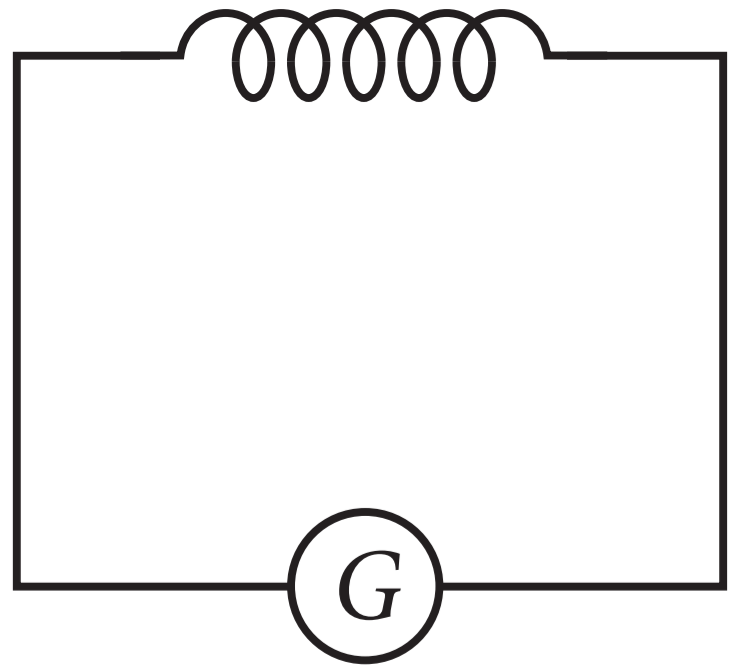
When a current/ flows through a coil, flux linked with it is $\phi=\text{LI},$ where L is a constant known as self inductance of the coil. Any change in current sets up an induced emf in the coil. Tims, self inductance of a coil is the induced emf set up in it when the current passing through it changes at the unit rate. It is a measure of the opposition to the growth or the decay of current flowing through the coil. Also, value of self inductance depends on the number of turns in the solenoid, its area of cross-section and the relative permeability of its core material.
  1. The inductance in a coil plays the same role as:
  1. Inertia in mechanics.
  2. Energy in mechanics.
  3. Momentum in mechanics.
  4. Force in mechanics.
  1. A current of 2.5A flows through a coil of inductance 5H. The magnetic flux linked with the coil is:
  1. 0.5Wb
  2. 12.5Wb
  3. Zero
  4. 2Wb
  1. The inductance L of a solenoid depends upon its radius R as:
  1. $\text{L}\propto\text{R}$
  2. $\text{L}\propto\frac{1}{\text{R}}$
  3. $\text{L}\propto\text{R}^2$
  4. $\text{L}\propto\text{R}^3$
  1. The unit of self-inductance is:
  1. Weber ampere
  2. Weber$^{-1}$ ampere
  3. Ohm second
  4. Farad
  1. The induced e.m.f. in a coil of 10 henry inductance in which current varies from 9A to 4A in 0.2 second is:
  1. 200V
  2. 250V
  3. 300V
  4. 500V
In a TV picture tube electrons are ejected from the cathode with negligible speed and reach a velocity of $5 \times 10^6m/s$ in travelling one centimeter. Assuming straight line motion, find the constant force exerted on the electron. The mass of the electron is $9.1 \times 10^{-31}kg.$
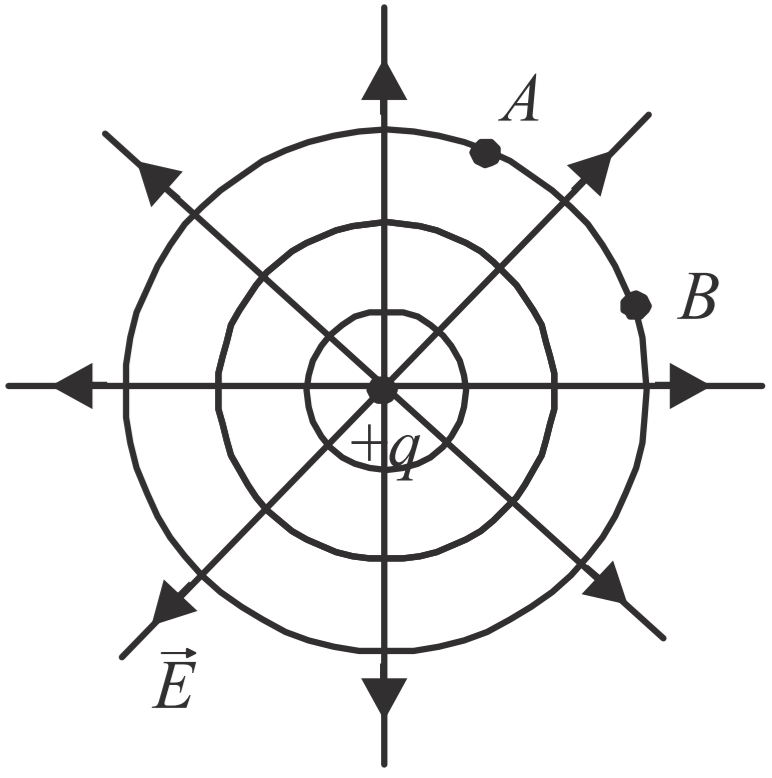
For the various charge systems, we represent equipotential surfaces by curves and line of force by full line curves. Between any two adjacent equipotential surfaces, we assume a constant potential difference the equipotential surfaces of a single point charge are concentric spherical shells with their centres at the point charge. As the tines of force point radially outwards, so they are perpendicular to the equipotential surfaces at all points.
  1. Identify the wrong statement.
  1. Equipotential surface due to a single point charge is spherical.
  2. Equipotential surface can be constructed for dipoles too.
  3. The electric field is normal to the equipotential surface through the point.
  4. The work done to move a test charge on the equipotential surface is positive.
  1. Nature of equipotential surface for a point charge is:
  1. Ellipsoid with charge at foci.
  2. Sphere with charge at the centre of the sphere.
  3. Sphere with charge on the surface of the sphere.
  4. Plane with charge on the surface.
  1. A spherical equipotential surface is not possible:
  1. Inside a uniformly charged sphere.
  2. For a dipole.
  3. Inside a spherical condenser.
  4. For a point charge.
  1. The work done in carrying a charge q once round a circle of radius a with a charge Q at its centre is:
  1. $\frac{\text{qQ}}{4\pi\in_0\text{a}}$
  2. $\frac{\text{qQ}}{4\pi\in_0\text{a}^2}$
  3. $\frac{\text{q}}{4\pi\in_0\text{a}}$
  4. $\text{Zero}$
  1. The work done to move a unit charge along an equipotential surface from P to Q:
  1. Must be defined as $-\int\limits_{\text{P}}^{\text{Q}}\vec{\text{E}}\cdot\text{d}\vec{\text{l}}.$
  2. Is zero.
  3. Can have a non-zero value.
  4. Both (a) and (b) are correct.
The mean free path of electrons in a gas in a discharge tube is inversely proportional to the pressure inside it. The Crookes dark space occupies half the length of the discharge tube when the pressure is 0.02mm of mercury. Estimate the pressure at which the dark space will fill the whole tube.
The entering flux from a closed surface is $2 \times 10^3$ Newton-metre ${ }^2 /$ Coulomb and the emerging flux is $8 \times 10^3$ Newton-metre ${ }^2 /$ Coulomb. Find the value of charge enclosed in the surface.
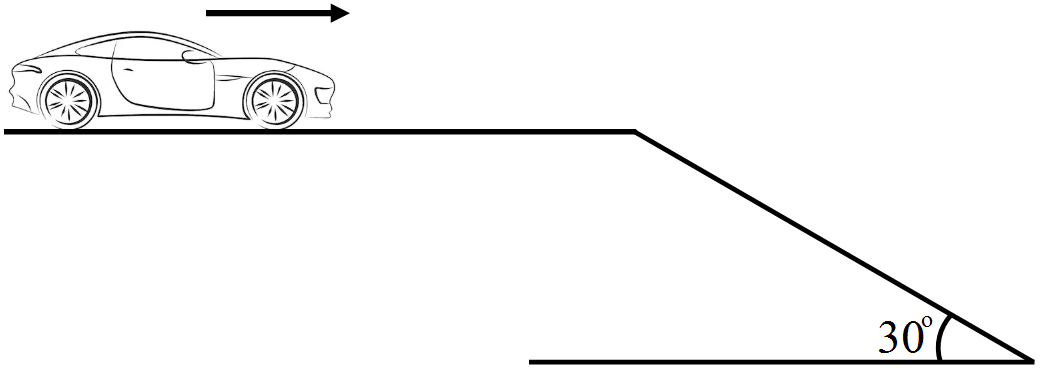
A car is going at a speed of 21.6km/hr when it encounters a 12.8m long slope of angle 30°. The friction coefficient between the road and the tyre is $\frac{1}{2\sqrt{3}}.$ Show that no matter how hard the driver applies the brakes, the car will reach the bottom with a speed greater than 36km/hr. Take $g = 10m/s^2.$