MCQ
A heavy solid sphere is thrown on a horizontal rough surface with initial velocity $u$ without rolling. What will be its speed, when it starts pure rolling motion?
  • A
    $\frac{3 u}{5}$
  • B
    $\frac{2 u}{5}$
  • $\frac{5 u}{7}$
  • D
    $\frac{2 u}{7}$

Answer

Correct option: C.
$\frac{5 u}{7}$
c
(c)

Using angular momentum conservation

$m u r=m v r+\frac{2}{5} m r^2\left(\frac{v}{r}\right)$

$u=7 \frac{v}{5}$

$v=\frac{5 u}{7}$

Need a full question paper?

Generate a complete, print-ready paper with questions like this in minutes — across 16+ boards, with answer keys.
Start Generating Free

Similar questions

Two stones are dropped down simultaneously from different heights. At the starting time, the distance between them is $30\ cm.$ After $1\ s,$ the distance between the two stones will be $(g = 10\ ms^{-2}).$
A ball is thrown upward with an initial velocity $V_0$ from the surface of the earth. The motion of the ball is affected by a drag force equal to $m\gamma {v^2}$ (where $m$ is mass of the ball, $v$ is its Instantneous velocity and $\gamma $ is a constant). Time taken by the ball to rise to its zenith is
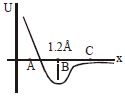
The potential energy $U$ between two molecules as a function of distance $x$ between them is shown $A, B, $ $\&$ $C$ are points for which $x$ $=$ $0.6Å, 1.2 Å $ $\&$ $1.8 Å$ respectively. At  $A, B $ $\&$ $C$ force between two molecules is :-
$A$ particle is moving along a circular path of radius $R$ in such a way that at any instant magnitude of radial acceleration & tangential acceleration are equal. If at $t = 0$ velocity of particle is $V_0$, the time period of first revolution of the particle is 
Magnitude of vector which comes on addition of two vectors, $6\hat i + 7\hat j$ and $3\hat i + 4\hat j$ is
The position vectors of radius are $2\hat i + \hat j + \hat k$ and $2\hat i - 3\hat j + \hat k$ while those of linear momentum are $2\hat i + 3\hat j - \hat k.$ Then the angular momentum is
A car starts from rest and accelerates at $5 \,\mathrm{~m} / \mathrm{s}^{2}$. At $t=4 \mathrm{~s}$, a ball is dropped out of a window by a person sitting in the car. What is the velocity and acceleration of the ball at $\mathrm{t}=6\, \mathrm{~s}$ ?

(Take g $\left.=10\, \mathrm{~m} / \mathrm{s}^{2}\right)$
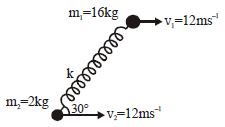
Two particles with mass $m_1$ = $16\ kg$ and $m_2$ = $2\ kg$ slide as unit with a common velocity of $12\ ms^{-1}$ on a level frictionless surface. Between them is a compressed massless spring with spring constant $k$ = $100\ Nm^{-1}$ . The spring, originally compressed by $25\ cm$ , is suddenly released, sending the two masses, which are connected to the spring, flying apart from each other. The orientation of the spring w.r.t. the initial velocity is shown in diagram. What is the relative velocity of separation in $ms^{-1}$ , after the particles lose contact? ................$m/s$
If the earth suddenly shrinks to $\frac{1}{64}$ th of its original volume with its mass remaining the same, the period of rotation of earth becomes $\frac{24}{ x } h$. The value of $x$ is $.......$
$m x^{2}-b x+k=0$

Find time after which to the energy will become half of initial maximum value in damped force oscillation.