MCQ
A hole in a $P-$ type semiconductor is
  • A
    An excess electron
  • A missing electron
  • C
    A missing atom
  • D
    A donor level

Answer

Correct option: B.
A missing electron
b
A hole in a $P-$type semiconductor is a missing electron.

Need a full question paper?

Generate a complete, print-ready paper with questions like this in minutes — across 16+ boards, with answer keys.

Start Generating Free

Similar questions

The recoil speed of a hydrogen atom after it emits a photon in going from $n =5$ state to $n =1$ state will be ..... $m/s$
Two protons move parallel to each other, keeping distance $r$ between them, both moving with same  velocity $\vec V\,$. Then the ratio of the electric and magnetic force of interaction between them is
A diffraction pattern is obtained by using beam of red. light what will happen, if red light is replced by the blue light ?
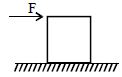
A force $F$ is applied on the top of a cube as shown in the figure. The coefficient of friction between the cube and ground is $\mu$. If $F$ is gradually increased the cube will topple before sliding then range of $\mu$ is:-
If the earth suddenly shrinks to $\frac{1}{64}$ th of its original volume with its mass remaining the same, the period of rotation of earth becomes $\frac{24}{ x } h$. The value of $x$ is $.......$
A parallel plate capacitor is to be designed, using a dielectric of dielectric constant $5$, so as to have a dielectric strength of $10^9\;Vm^{-1}$ . If the voltage rating of the capacitor is $12\;kV$, the minimum area of each plate required to have a capacitance of $80\;pF$ is
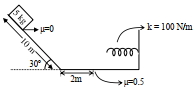
A block is simply released from the top of an inclined plane as shown in the figure above. The maximum compression in the spring when the block hits the spring is :
In an experiment of find the focal length of a concave mirror a graph is drawn between the magnitudes of $u$ and $v$. The graph looks like
An iron ball and a wooden ball of the same radius are released from a height $‘h’$ in vacuum. The time taken by both of them to reach the ground is equal is based on 
Consider a car moving along a straight horizontal road with a speed of $72\, km/h$. If the coefficient of kinetic friction between the tyres and the road is $0.5,$ the shortest distance in which the car can be stopped is ........ $m$ .$[g = 10\,m{s^{ - 2}}]$