MCQ
A hole in a $P-$ type semiconductor is
  • A
    An excess electron
  • A missing electron
  • C
    A missing atom
  • D
    A donor level

Answer

Correct option: B.
A missing electron
b
A hole in a $P-$type semiconductor is a missing electron.

Need a full question paper?

Generate a complete, print-ready paper with questions like this in minutes — across 16+ boards, with answer keys.

Start Generating Free

Similar questions

Two small conducting spheres of equal radius have charges +10Μc and -20 μC respectively and placed at a distance R from each other experience force $F_1$. If they are brought in contact and separated to the same distance, they experience force $F_2$. The ratio of $F_1$ to $F_2$ is
Biological importance of Ozone layer is
Assertion : In Lyman series, the ratio of minimum and maximum wavelength is $\frac{3}{4}$.

Reason : Lyman series constitute spectral lines corresponding to transition from higher energy to ground state of hydrogen atom.
The self inductance of a coil is $5 \,henry$, a current of $1 \,amp$ change to $2 \,amp$ within $5\,second$ through the coil. The value of induced $e.m.f$. will be.....$volt$
The number of turns of primary and secondary coils of a transformer are 5 and 10 respectively and the mutual inductance of the transformer is 25 henry. Now the number of turns in the primary and secondary of the transformer are made 10 and 5 respectively. The mutual inductance of the transformer in henry will be
Two capacitors whose capacitances are $C _1$ and $C _2$ If they are given equal charges then the ratio of the energies stored in them will be :
When we touch the terminals of a high voltage capacitor, even after a high voltage has been cut off, then the capacitor has a tendency to
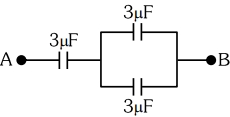
The equivalent capacitance of the system shown in the following circuit is $...........\mu F$
For a normal eye, the cornea of eye provides a converging power of $40\,\, D$ and the least converging power of the eye lens behind the cornea is $20\,\, D.$ Using this information, the distance between the retina and the cornea­eye lens can be estimated to be.........$ cm$
An electron collides with a free molecule initially in its ground state. The collision leaves the molecule in an excited state that is metastable and does not decay to the ground state by radiation. Let $K$ be the sum of the initial kinetic energies of the electron and the molecule and $p$ be the sum of their initial momenta. Let $K^{\prime}$ and $p ^{\prime}$ represent the same physical quantities after the collision. Then,