MCQ
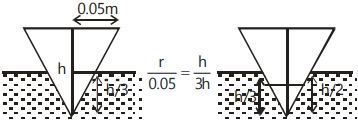
A hollow cone floats with its axis vertical upto one-third of its height in a liquid of relative density $0.8$ and with its vertex submerged. When another liquid of relative density $\rho$ is filled in it upto one-third of its height, the cone floats upto half its vertical height. The height of the cone is $0.10$ $m$ and the radius of the circular base is $0.05$ $m$. The specific gravity $\rho$ is given by
  • A
    $1.0$
  • B
    $1.5$
  • C
    $2.1$
  • $1.9$

Answer

Correct option: D.
$1.9$
d
$h=0.1 \mathrm{m}$

By force balance

$\mathrm{mg}=0.8\left(\frac{1}{3} \pi\left(\frac{0.05}{3}\right)^{2}\left(\frac{\mathrm{h}}{3}\right)\right)$   $...(i)$

When liquid is added

$\mathrm{Mg}+\rho\left(\frac{1}{3} \pi\left(\frac{0.05}{3}\right)^{2}\left(\frac{\mathrm{h}}{3}\right)\right)$

$=0.8\left(\frac{1}{3} \pi\left(\frac{0.05}{2}\right)^{2}\left(\frac{\mathrm{h}}{2}\right)\right)$  $...(ii)$

By $(i)$ and $(ii)$

$(0.8)\left(\frac{1}{3} \pi \frac{(0.05)^{2} h}{3^{3}}\right)+\rho\left(\frac{1}{3} \pi \frac{(0.05)^{2} h}{3^{3}}\right)$

$=0.8\left(\frac{1}{3} \pi \frac{(0.05)^{2} h}{2^{3}}\right)$

$\frac{0.8+p}{3^{3}}=\frac{0.8}{8}=0.1$

$0.8+\rho=2.7$

$\rho=1.9$

Need a full question paper?

Generate a complete, print-ready paper with questions like this in minutes — across 16+ boards, with answer keys.

Start Generating Free

Similar questions

The earth (mass $ = 6 \times {10^{24}}\,kg)$) revolves round the sun with angular velocity $2 \times {10^{ - 7}}\,rad/s$ in a circular orbit of radius $1.5 \times {10^8}\,km$. The force exerted by the sun on the earth in newtons, is
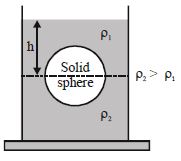
A solid sphere of radius $r$ is floating at the  interface of two immiscible liquids of densities $\rho_1$ and $\rho_2\,\, (\rho_2 > \rho_1),$ half of its volume lying in each. The height of the upper liquid column from the interface of the two liquids is $h.$ The force exerted on the sphere by the upper liquid is $($ atmospheric pressure $= p_0\,\,\&$ acceleration due to gravity is $g) $
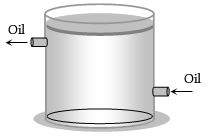
The top of insulated cylindrical container is covered by a disc having emissivity $0.6$ and thickness $1\, cm$. The temperature is maintained by circulating oil as shown in figure. If temperature of upper surface of disc is $127^o C$ and temperature of surrounding is $27^o C$, then the radiation loss to the surroundings will be (Take $\sigma = \frac{{17}}{3} \times {10^{ - 8}}W/{m^2}{K^4})$
A pulley of rad ius $2\ m$ is rotated about its axis by a force $ F = (20t -5t^2)$  newton (where tis measured in seconds) applied tangentially. If the moment ofinertia of the pulley about its axis ofrotation is $10\ kg-m^2$ the number ofrotations made by the pulley before its d irection of motion is reversed , is
Two waves represented by the following equations are travelling in the same medium ${y_1} = 5\sin 2\pi (75t - 0.25x)$, ${y_2} = 10\sin 2\pi (150t - 0.50x)$ The intensity ratio ${I_1}/{I_2}$ of the two waves is
A wire under tension $T$ emits a note of fundamental frequency $200Hz.$ If the tension is increased by $3T,$ the fundamental frequency will be:
A particle experiences a variable force $\overrightarrow{ F }=\left(4 x \hat{ i }+3 y ^{2} \hat{ j }\right)$ in a horizontal $x - y$ plane. Assume distance in meters and force is newton. If the particle moves from point $(1,2)$ to point $(2,3)$ in the $x-y$ plane, the Kinetic Energy changes by............$j$
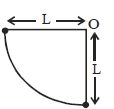
The mass of the $bob$ of a simple pendulum of length $L$ is $m$. If the $bob$ is left from its horizontal position then the speed of the $bob$ and tension in the thread in the lowest position of the $bob$ will be respectively
Two constant forces ${F_1} = 2\hat i - 3\hat j + 3\hat k\,$($N$) and ${F_2} = \hat i + \hat j - 2\hat k\,$($N$) act on a body and displace it from the position ${r_1} = \hat i + 2\hat j - 2\hat k\,$($m$) to the position ${r_2} = 7\hat i + 10\hat j + 5\hat k\,$($m$). What is the work done......... $J$
A heavy ring of mass m is clamped on the periphery of al light circular disc. A small particle having equal mass is clamped at the centre of the disc. The system is rotated in such a way that the centre moves in a circle of radius r with a uniform speed v. We conclude that an external force: