MCQ
A hollow sphere and a solid sphere having same mass and same radius are rolled down a rough inclined plane-
  • A
    The hollow sphere reaches the bottom first
  • The solid sphere reaches the bottom with greater speed
  • C
    The solid sphere reaches the bottom with greater kinetic energy
  • D
    The two spheres will reach the bottom with same linear momentum

Answer

Correct option: B.
The solid sphere reaches the bottom with greater speed
b
$v=\sqrt{\frac{2 g h}{1+\frac{k^{2}}{r^{2}}}}$ solid sphere reaches with

larger speed since potential energy converted into kinetic energy so kinetic energy of both at bottom will be same since solid sphere has larger velocity so its momentum will be larger.

Need a full question paper?

Generate a complete, print-ready paper with questions like this in minutes — across 16+ boards, with answer keys.

Start Generating Free

Similar questions

A unit mass of solid converted to liquid at its melting point. Heat is required for this process is:
A surface of area $S$ is placed perpendicular to the direction of travel of a plane wave. The energy per unit time intercepted by the surface is $E$ when the amplitude of the wave is $A$ . The area of the surface is reduced to $\frac{1}{2} \ S$ and the amplitude of the wave is increased to $2\ A$ . What is the energy per unit time intercepted by this smaller surface?
Which of the diagrams shown in most closely shows the variation in kinetic energy of the earth as it moves once around the sun in its elliptical orbit?

Which of the following statements is/are not an assumption of the kinetic theory for an ideal gas?
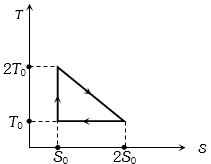
The temperature-entropy diagram of a reversible engine cycle is given in the figure. Its efficiency is
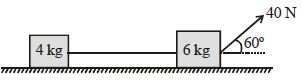
The tension in the string which connected the blocks as shown in the following figure  ............ $ N$
Two perfectly identical wires are in unison. When the tension in one wire is increased by $1\%$, then on sounding them together $3$ beats are heard in $2 \,sec$. The initial frequency of each wire is .... ${\sec ^{ - 1}}$
As temperature tends to zero i.e., T → 0
If the ratio of cross-sections of a tube of unequal radius at two places is 1 : 2, then for an incompressible fluid the ratio of the mass of the fluid entering and exiting the tube will be :
Two straight metallic strips each of thickness $t$ and length $\ell$ are rivetted together. Their coefficients of linear expansions are $\alpha_1$ and $\alpha_2$. If they are heated through temperature $\Delta T$, the bimetallic strip will bend to form an arc of radius