Question
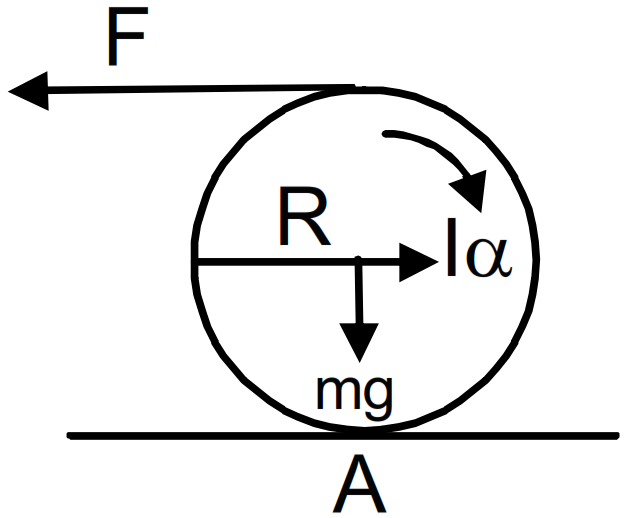
A hollow sphere of radius R lies on a smooth horizontal surface. It is pulled by a horizontal force acting tangentially from the highest point. Find the distance travelled by the sphere during the time it makes one full rotation.
Answer


Taking moment about the centre of hollow sphere we will get

$\text{F}\times\text{R}=\frac{2}{3}\text{MR}^2\alpha$

$\Rightarrow\alpha=\frac{3\text{F}}{2\text{MR}}$

Again, $2\pi=\Big(\frac{1}{2}\Big)\alpha\text{t}^2$ $\Big(\text{From}\ \theta=\omega_0\text{t}+\Big(\frac{1}{2}\Big)\alpha\text{t}^2\Big)$

$\Rightarrow\text{t}^2=\frac{8\pi\text{MR}}{\text{3F}}$

$\Rightarrow\text{a}_{\text{c}}=\frac{\text{F}}{\text{m}}$

$\Rightarrow\text{X}=\Big(\frac{1}{2}\Big)\text{a}_{\text{c}}\text{t}^2=\Big(\frac{1}{2}\Big)=\frac{4\pi\text{R}}{3}$

Need a full question paper?

Generate a complete, print-ready paper with questions like this in minutes — across 16+ boards, with answer keys.
Start Generating Free

Similar questions

Define ionisation energy.
When in a hydrogen atom an electron is replaced by such a particle whose mass is 200 times the mass of the electron and its charge is the same as that of electron, then how will its ionisation energy be changed ?
Calculate the energy that can be obtained from 1kg of water through the fusion reaction
2H + 2H → 3H + p.
Assume that 1.5 × 10⁻²% of natural water is heavy water D2O (by number of molecules) and all the deuterium is used for fusion.
Figure shows two blocks of masses m and M connected by a string passing over a pulley. The horizontal table over which the mass m slides is smooth. The pulley has a radius r and moment of inertia I about its axis and it can freely rotate about this axis. Find the acceleration of the mass M assuming that the string does not slip on the pulley.

Draw a graph showing change of alternating current with frequency in LCR series resonant circuit and obtain expression for bandwidth.
  1. Define self-inductance. Write its SI units.
  2. A long solenoid with 15 turns per cm has a small loop of area 2.0 cm2 placed inside the solenoid normal to its axis. If the current carried by the solenoid changes steadily from 2.0 A to 4.0 A in 0.1 s, what is the induced emf in the loop while the current is changing?
A long charged cylinder of linear charge density $+\lambda_1$ is surrounded by a hollow coaxial conducting cylinder of linear charge density $-\lambda_2$. Use Gauss’s law to obtain expressions for the electric field at a point (i) in the space between the cylinders, and (ii) outside the larger cylinder.
Derive the formula for conductivity and resistivity of metals by obtaining the relationship between drift velocity and current density.
An ideal diode should pass a current freely in one direction and should stop it completely in the opposite direction. Which is closer to ideal-vacuum diode or a p-n junction diode?
The Q value of a nuclear reaction A + b → C + d is defined by

Q = [ mA + mb – mC – md]c2

where the masses refer to the respective nuclei. Determine from the given data the Q-value of the following reactions and state whether the reactions are exothermic or endothermic.

  1. $^1_1\text{H}+^3_1\text{H}\rightarrow^2_1\text{H}+^2_1\text{H}$
  2. $^{12}_6\text{C}+^{12}_6\text{C}\rightarrow^{20}_{10}\text{Ne}+^4_2\text{He}$

Atomic masses are given to be

$\text{m}(^2_1\text{H})=2.014102\text{ u}$

$\text{m}(^3_1\text{H})=3.016049\text{ u}$

$\text{m}(^{12}_6\text{C})=12.000000\text{ u}$

$\text{m}(^{20}_{10}\text{Ne})=19.992439\text{ u}$

A convex lens made up of glass of refractive index 1.5 is dipped, in turn, in:

  1. Medium A of refractive index 1.65
  2. Medium B of refractive index 1.33

Explain, giving reasons, whether it will behave as a converging lens or a diverging lens in each of these two media.