Question
A horizontal cesium plate ($\phi$ = 1.9eV) is moved vertically downward at a constant speed u in a room full of radiation of wavelength 250 run and above. What should be the minimum value of u so that the vertically upward component of velocity is nonpositive for each photoelectron?
Answer

When $\lambda=250\text{nm}$Energy of photon
$=\frac{\text{hc}}{\lambda}=\frac{1240}{250}=4.96\text{ev}$
$\therefore\text{K.E.}=\frac{\text{hc}}{\lambda}-\text{w}=4.96-1.9\text{ev.}$
Velocity to be non positive for each photo electron
The minimum value of velocity of plate should be = velocity of photo electron
$\therefore$ Velocity of photo electron $=\sqrt{\frac{2\text{KE}}{\text{m}}}$
$=\sqrt{\frac{3.06}{9.1\times10^{-31}}}$
$=\sqrt{\frac{3.06\times1.6\times10^{-19}}{9.1\times10^{-31}}}=1.04\times10^6\text{m/sec.}$

Need a full question paper?

Generate a complete, print-ready paper with questions like this in minutes — across 16+ boards, with answer keys.

Start Generating Free

Similar questions

$a.$ Derive an expression for the potential energy of an electric dipole in a uniform electric field. Explain conditions for stable and unstable equilibrium.
$b.$ Is the electrostatic potential necessarily zero at a point where the electric field is zero? Give an example to support your answer.
A capacitor of capacitance C is connected to a battery of emf $\in$ at t = 0 through a resistance R. Find the maximum rate at which energy is stored in the capacitor. When does the rate have this maximum value?
Use (i) the Ampere's law for H and (ii) continuity of lines of B, to conclude that inside a bar magnet, (a) lines of H run from the N pole to S pole, while (b) lines of B must run from the S pole to N pole.
State Biot-Savart statement. Obtain an expression for produced magnetic field due to a straight and limited length of current carrying conductor wire. Write its similarities and differences with coulomb's law of electrostatics.
Two monochromatic beams A and B of equal intensity I, hit a screen. The number of photons hitting the screen by beam A is twice that by beam B. Then what inference can you make about their frequencies?
A particle of mass 1g and charge $2.5 \times 10^{-4}C$ is released from rest in an electric field of $1.2 \times 10^4NC^{-1}.$​​​​​​​
  1. Find the electric force and the force of gravity acting on this particle. Can one of these forces be neglected in comparison with the other for approximate analysis?
  2. How long will it take for the particle to travel a distance of 40cm?
  3. What will be the speed of the particle after travelling this distance?
  4. How much is the work done by the electric force on the particle during this period?
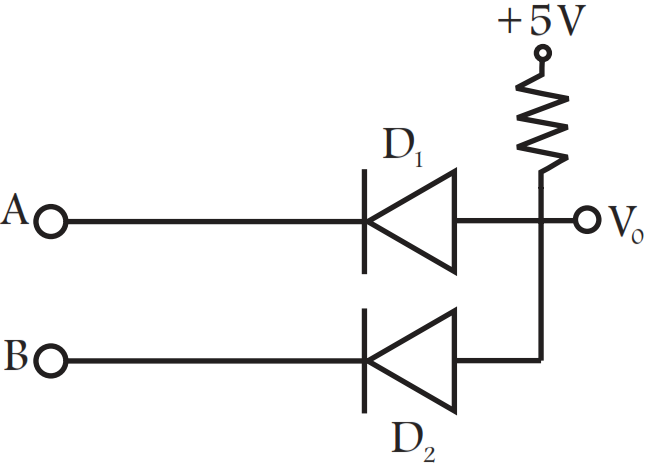
Write the truth table for the circuit shown in Fig. Name the gate that the circuit resembles.
A light beam of wavelength 400 run is incident on a metal plate of work function 2.2eV.
  1. A particular electron absorbs a photon and makes two collisions before coming out of the metal. Assuming that 10% of the extra energy is lost to the metal in each collision, find the kinetic energy of this electron as it comes out of the metal.
  2. Under the same assumptions, find the maximum number of collisions the electron can suffer before it becomes unable to come out of the metal.
A 5mm high pin is placed at a distance of 15cm from a convex lens of focal length 10cm. A second lens of focal length 5cm is placed 40cm from the first lens and 55cm from the pin. Find
  1. The position of the final image.
  2. Its nature.
  3. Its size.
Two ideal gases have the same value of $\frac{\text{C}_\text{P}}{\text{C}_\text{V}}=\gamma.$ What will be the value of this ratio for a mixture of the two gases in the ratio 1 : 2?