Question
A horizontal cesium plate ($\phi$ = l.9 eV) is moved vertically downward at a constant speed u in a room full of radiation of wavelength 250 run and above. What should be the minimum value of u so that the vertically upward component of velocity is nonpositive for each photoelectron?
Answer

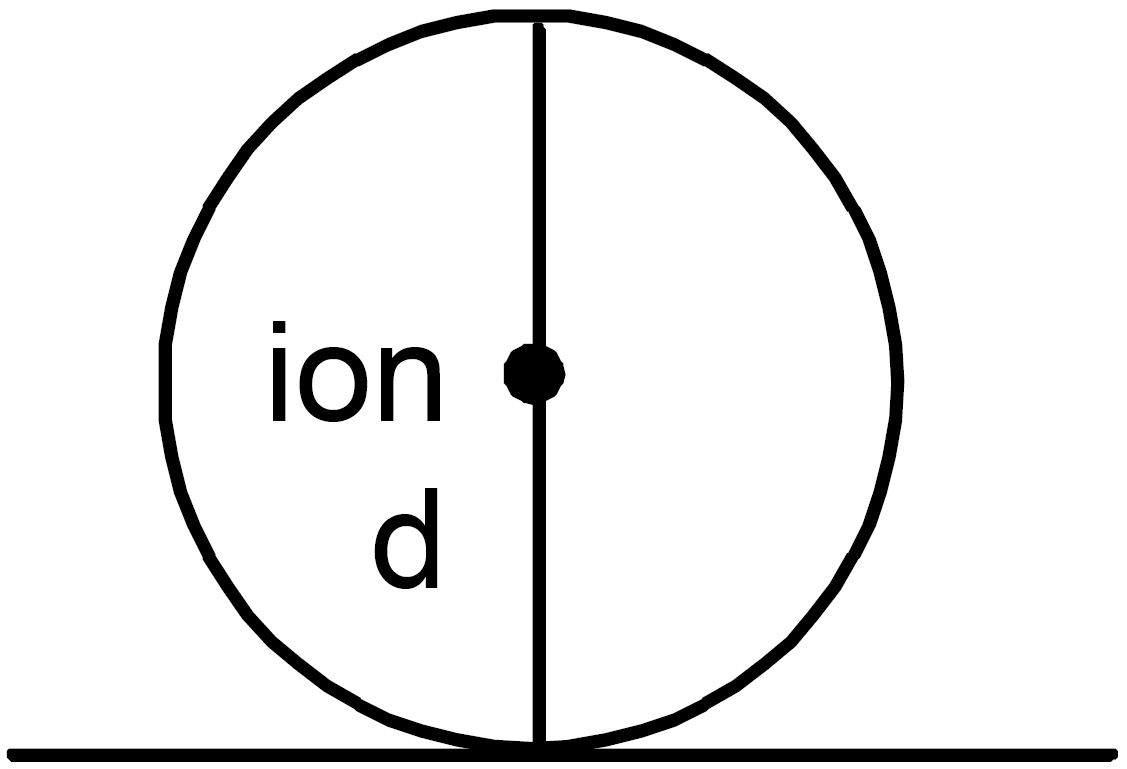
Work function $=\phi,$ distance = dThe particle will move in a circle
When the stopping potential is equal to the potential due to the singly charged ion at that point.
$\text{eV}_0=\frac{\text{hc}}{\lambda}-\phi$
$\Rightarrow\text{v}_0=\Big(\frac{\text{hv}}{\lambda}-\phi\Big)\frac{1}{\text{e}}$
$\Rightarrow\frac{\text{ke}}{2\text{d}}=\Big(\frac{\text{hc}}{\lambda}-\phi\Big)\frac{1}{\text{e}}$
$\Rightarrow\frac{\text{ke}}{\text{2d}}=\frac{\text{hc}}{\lambda}-\phi$
$\Rightarrow\frac{\text{hc}}{\lambda}=\frac{\text{ke}^2}{2\text{d}}+\phi=\frac{\text{ke}^2+2\text{d}\phi}{2\text{d}}$
$\Rightarrow\lambda=\frac{\text{hc 2d}}{\text{ke}^2+2\text{d}\phi}=\frac{2\text{hcd}}{\frac{1}{4\pi\omega_0\text{e}^2}2\text{d}\phi}=\frac{8\pi\omega_0\text{hcd}}{\text{e}^2+8\pi\omega_0\text{d}\phi}$

Need a full question paper?

Generate a complete, print-ready paper with questions like this in minutes — across 16+ boards, with answer keys.

Start Generating Free

Similar questions

The magnetic field inside a long solenoid having $50$ turns/cm is increased from $2·5 × 10.3T$ to $2.5T$ when an iron core of cross-sectional area $4cm^2$ is inserted into it. Find:
  1. The current in the solenoid.
  2. The magnetization I of the core.
  3. The pole strength developed in the core.
A force $3\hat{\text{i}}+2\hat{\text{j}}$ displaces a 1kg mass from $\hat{\text{i}}+\hat{\text{j}}$ to $-\hat{\text{i}}+2\hat{\text{j}}$. Find the work done.
Two sitar strings A and B playing the note ‘Ga’ are slightly out of tune and produce beats of frequency $6Hz$. The tension in the string A is slightly reduced and the beat frequency is found to reduce to $3Hz$. If the original frequency of A is $324Hz$, what is the frequency of B?
A wire of length L and radius r is clamped rigidly at one end. When the other end of the wire is pulled by a force f, its length increases by l. Another wire of the same material of length 2L and radius 2r, is pulled by a force 2f. Find the increase in length of this wire.
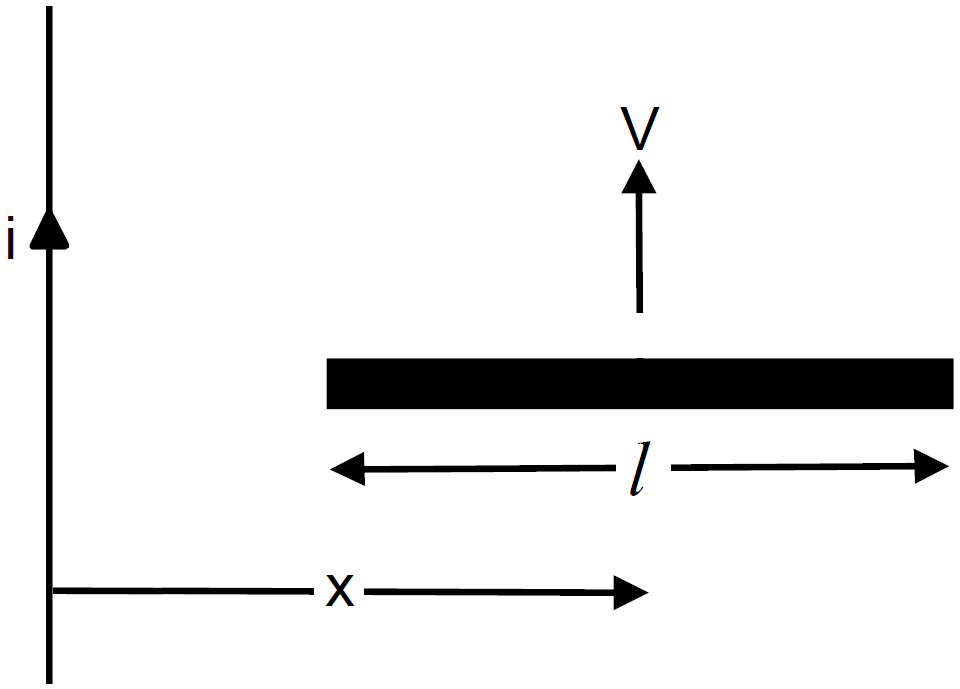
Figure shows a straight, long wire carrying a current i and a rod of length l coplanar with the wire and perpendicular to it. The rod moves with a constant velocity v in a direction parallel to the wire. The distance of the wire from the centre of the rod is x. Find motional emf induced in the rod.
The amplitude of a wave disturbed propagating in the positive x direction is given by
$\text{y}=\frac{1}{1+\text{x}^2}$ at t = 0 and $\text{y}=\frac{1}{1+(\text{x}-1)^2}$ at t = 2s
where x and y in metre. The shape of disturbance does not change during the propagation. What is the velocity of the wave?
If the linear momentum is increased by 50%, what is the change in its kinetic energy?
A and B are two particles having the same mass 'm'. A is moving along x-axis with a speed of $10ms^{-1}$ and B is at rest. After undergoing a perfectly elastic collision with B, particle A get scattered through an angle of $30°$. What is the direction of the motion of B and the speeds of A and B after the collision?
India has had a long and unbroken tradition of great scholarship-in mathematics, astronomy, linguistics, logic and ethics. Yet, in parallel with this, several superstitious and obscurantistic attitudes and practices flourished in our society and unfortunately continue even today-among many educated people too. How will you use your knowledge of science to develop strategies to counter these attitudes?
Two pulleys of masses $12kg$ and $8kg$ are connected by a fine string hanging over a fixed pulley as shown. Over the $8kg$ pulley is hung a fine string with masses $4kg$ and M. Over the $12kg$ pulley is hung another fine string with masses $3kg$ and $6kg$. Calculate M so that the string over the fixed pulley remains stationary.