MCQ
A hydraulic automobile lift is designed to lift cars with a maximum mass of $3000\, kg$. The area of cross section a of piston carrying the load is $425\, cm ^{2}$. What is the maximum pressure () would smaller piston have to bear ?
  • A
    $15.82 \times 10^{5} Pa$
  • B
    $1.12 \times 10^{5} Pa$
  • C
    $2.63 \times 10^{5} Pa$
  • $6.92 \times 10^{5} Pa$

Answer

Correct option: D.
$6.92 \times 10^{5} Pa$
d
The force acting on bigger piston is,

$F=m g$

$F=3000 kg \times 9.8 m / s ^{2}$

$F=29400 N$

The area of the piston is,

$A=425 cm ^{2}=425 \times 10^{-4} m ^{2}$

The pressure acting on the bigger piston is,

$P=\frac{F}{A}$

$P=\frac{29400 N }{425 \times 10^{-4} m ^{2}}$

$P=6.92 \times 10^{5} Pa$

Need a full question paper?

Generate a complete, print-ready paper with questions like this in minutes — across 16+ boards, with answer keys.

Start Generating Free

Similar questions

A mass of diatomic gas $(\gamma = 1 .4)$ at a pressure of $2$ atmospheres is compressed adiabatically so that its temperature rises from $27^o C$ to $927^o C.$ The pressure of the gas in the final state is  ...... $atm$
The potential energy function (in J) of a particle in a region of space is given as $U=\left(2 x^2+3 y^3+2 z\right)$. Here $\mathrm{x}, \mathrm{y}$ and $\mathrm{z}$ are in meter. The magnitude of $\mathrm{x}$ - component of force (in $\mathrm{N}$ ) acting on the particle at point $\mathrm{P}(1,2,3)\ \mathrm{m}$ is:
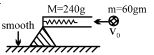
$A$ ball of mass $m = 60gm$ is shot with speed $v_0 = 22m/s$ into the barrel of spring gun of mass $M = 240g$ initially at rest on $a$ frictionless surface. The ball sticks in the barrel at the point of maximum compression of the spring. The speed of the spring gun after the ball stops relative to the barrel, is
A hollow sphere of mass $1 \,kg$ and radius $10 \,cm$ is free to rotate about its diameter. If a force of $30 \,N$ is applied tangentially to it, its angular acceleration is (in $rad / s ^2$ )
$150 \,g$ of ice is mixed with $100 \,g$ of water at temperature $80^{\circ} C$. The latent heat of ice is $80 cal / g$ and the specific heat of water is $1 cal / g ^{\circ} C$. Assuming no heat loss to the environment, the amount of ice which does not melt is ........... $g$
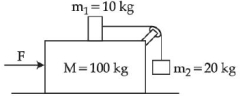
Three masses $M =100\,kg , m _{1}=10\,kg$ and $m_{2}=20\,kg$ are arranged in a system as shown in figure. All the surfaces are frictionless and strings are inextensible and weightless. The pulleys are also weightless and frictionless. $A$ force $F$ is applied on the system so that the mass $m_{2}$ moves upward with an acceleration of $2\,ms ^{-2}$. The value of $F$ is $......N$

$\left(\right.$ Take $\left.g =10\,ms ^{-2}\right)$

A gas expands adiabatically at constant pressure such that its temperature $T \propto \frac{1}{{\sqrt V }}$, the value of ${C_P}/{C_V}$ of gas is
A spacecraft of mass $M$ moves with velocity $V$ in free space at first, then it explodes breaking into two pieces. If after explosion a piece of mass $m$ comes to rest, the other piece of spacecraft will have a velocity
A spherical solid ball of volume $V$ is made of a material of density $\rho_1$ . It is falling through a liquid of density $\rho_2 (\rho_2 < \rho_1 )$. Assume that the liquid applies a viscous force on the ball that is proportional to the square of its speed $v$, i.e., $F_{viscous}= -kv^2 (k >0 )$,The terminal speed of the ball is 
A particle moves from the point $\left( {2.0\hat i + 4.0\hat j} \right)\,m$, at $t = 0$ with an initial velocity $\left( {5.0\hat i + 4.0\hat j} \right)\,m{s^{ - 1  }}$. It is acted upon by a constant force which produces a constant acceleration $\left( {4.0\hat i + 4.0\hat j} \right)\,m{s^{ - 2}}$. What is the distance of the particle from the origin at time $2\,s$