MCQ
A hydrogen atom in ground state absorbs $10.2 eV$ of energy. The orbital angular momentum of the electron is increased by:
 
  • $1.05 \times 10^{-34} \mathrm{Js}$
  • B
    $2.11 \times 10^{-34} \mathrm{Js}$
  • C
    $3.16 \times 10^{-34} \mathrm{Js}$
  • D
    $4.22 \times 10^{-34} \mathrm{Js}$

Answer

Correct option: A.
$1.05 \times 10^{-34} \mathrm{Js}$
Let after absorption of energy, the hydrogen atom goes to the $n^{th}$ excited state.
Therefore, the energy absorbed can be written as,
$10.2=13.6\times\Big(\frac{1}{1^2}-\frac{1}{\text{n}^2}\Big)$
$\Rightarrow\frac{10.2}{13.6}=1-\frac{1}{\text{n}^2}$
$\Rightarrow\frac{1}{\text{n}^2}=\frac{13.6-10.2}{13.6}$
$\Rightarrow\frac{1}{\text{n}^2}=\frac{3.4}{13.6}$
$\Rightarrow\text{n}^2=4$
$\Rightarrow\text{n}=2$
The orbital angular momentum of the electron in the $n^{th}$ state is given by,
$\text{L}_\text{n}=\frac{\text{nh}}{2\pi}$
Change in the angular momentum, $\Delta\text{L}=\frac{2\text{h}}{2\pi}-\frac{\text{h}}{2\pi}=\frac{\text{h}}{2\pi}$
$\therefore\Delta\text{T}=1.05\times10^{-34}\text{Js}$

Need a full question paper?

Generate a complete, print-ready paper with questions like this in minutes — across 16+ boards, with answer keys.

Start Generating Free

Similar questions

Shear modulus is zero for
A hole is made at the bottom of the tank filled with water (density $1000\, kg/m^3$). If the total pressure at the bottom of the tank is $3$ atmosphere ($1$ atmosphere $= 10^5\, N/m^2$), then the velocity of efflux is
A motorcyclist is approaching a large wall with a velocity of $90\,km/hr$. A car is chasing him with a velocity of $108\,km/hr$. If the car sounds a horn at $30\,Hz,$ beat frequency heard by motorcyclist is ____ $Hz$ . Take velocity of sound $= 330\,m/s$ .
The total energy of water molecule is given by:
Match the temperature of a black body given in List-$I$ with an appropriate statement in List-$II$, and choose the correct option.

[Given: Wien's constant as $2.9 \times 10^{-3} \mathrm{~m}-\mathrm{K}$ and $\frac{\mathrm{hc}}{\mathrm{e}}=1.24 \times 10^{-6} \mathrm{~V}-\mathrm{m}$ ]

List-$I$ List-$II$
($P$) $2000 \mathrm{~K}$ ($1$) The radiation at peak wavelength can lead to emission of photoelectrons from a metal of work function $4 \mathrm{eV}$
($Q$) $3000 \mathrm{~K}$ ($2$) The radiation at peak wavelength is visible to human eye.
($R$) $5000 \mathrm{~K}$ ($3$) The radiation at peak emission wavelength will result in the widest central maximum of a single slit diffraction.
($S$) $10000 \mathrm{~K}$ ($4$) The power emitted per unit area is $1 / 16$ of that emitted by a blackbody at temperature $6000 \mathrm{~K}$.
  ($5$) The radiation at peak emission wavelength can be used to image human bones.
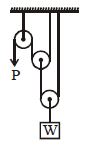
The ideal mechanical advantage of the combination of pulleys shown is
If vm is the velocity of sound in moist air, vd is the velocity of sound in dry air, under identical conditions of pressure and temperature
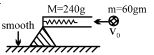
$A$ ball of mass $m = 60gm$ is shot with speed $v_0 = 22m/s$ into the barrel of spring gun of mass $M = 240g$ initially at rest on $a$ frictionless surface. The ball sticks in the barrel at the point of maximum compression of the spring. What fraction of initial kinetic energy of the ball is now stored in the spring?
A uniform thin ring of radius $R$ and mass $m$ suspended in a vertical plane from a point in its circumference. Its time period of oscillation is ........
A bowl filled with very hot soup cools from $98^{\circ}\,C$ to $86^{\circ}\,C$ in $2$ minutes when the room temperature is $22^{\circ}\,C$. $..........\,minutes$ long it will take to cool from $75^{\circ}\,C$ to $69^{\circ}\,C$ ?