Question
A hydrogen atom initially in the ground level absorbs a photon, which excites it to the $n = 4$ level. Determine the wavelength and frequency of photon.

Answer

For ground level $, n_1 = 1$
Let $E_1$ be the energy of this level. It ls known that $E_1$ Is related with $n_1$ as:
$\text{E}_1=\frac{-13.6}{\text{n}^2_1}\text{ eV}$
$=\frac{-13.6}{1^2}=-13.6\text{ eV}$
The atom is excited to a higher level $, n_2 = 4.$
Let $E_2$ be the energy of this level.
$\therefore\ \text{E}_2=\frac{-13.6}{\text{n}^2_2}\text{ eV}$
$=\frac{-13.6}{4^2}=-\frac{13.6}{16}\text{ eV}$
The amount of energy absorbed by the photon is given as:
$E = E_2 - E_1$
$=\frac{-13.6}{16}-\Big(-\frac{13.6}{1}\Big)$
$=\frac{13.6\times15}{16}\text{ eV}$
$=\frac{13.6\times15}{16}\times1.6\times10^{-19}=2.04\times10^{-18}\text{ J}$
For a photon of wavelenqtha. the expression of energy Is written as:
$\text{E}=\frac{\text{hc}}{\lambda}$
Where,
$h =$ Planck's constant $= 6.6 x 10^{-34} Js$
$c =$ Speed of light $= 3 x 10^8m/s$
$\therefore\ \lambda=\frac{\text{hc}}{\text{E}}$
$=\frac{6.6\times10^{-34}\times3\times10^8}{2.04\times10^{-18}}$
$=9.7\times10^{-8}\text{ m}=97\text{ nm}$
And, frequency of a photon is given by the relation,
$\text{v}=\frac{\text{c}}{\lambda}$
$=\frac{3\times10^8}{9.710^{-8}}\approx3.1\times10^{15}\text{ Hz}$
Hence, the wavelength of the photon is $97 \ nm$ while the frequency is $3.1 x 10^{15} Hz.$

Need a full question paper?

Generate a complete, print-ready paper with questions like this in minutes — across 16+ boards, with answer keys.
Start Generating Free

Similar questions

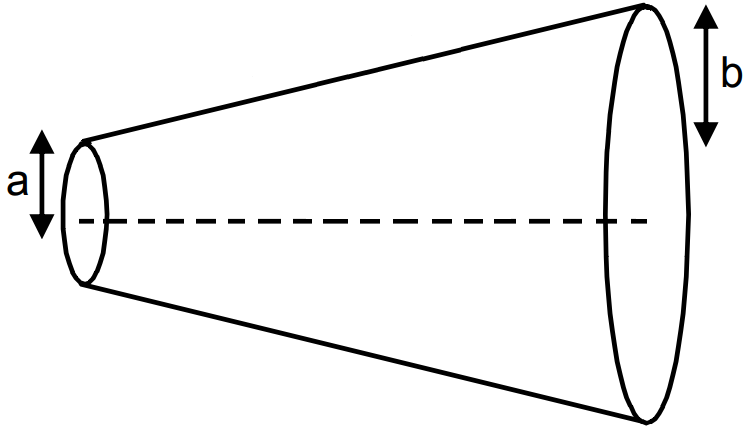
Figure. shows a conductor of length l with a circular cross-section. The radius of the cross-section varies linearly from a to b. The resistivity of the material is ρ. Assuming that b - a << l, find the resistance of the conductor.
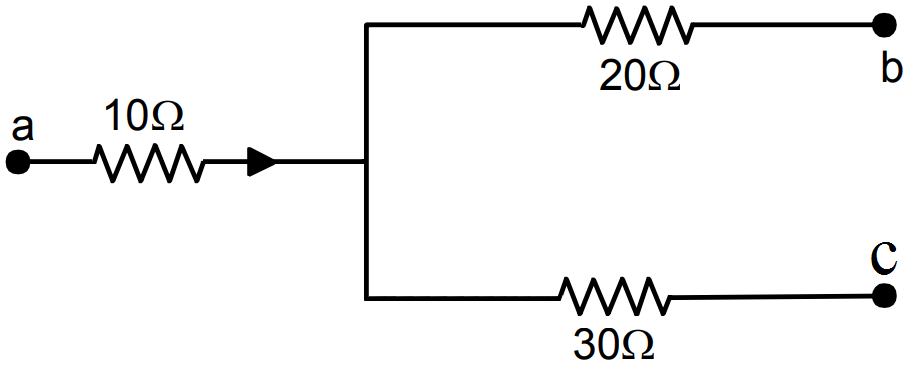
Figure. showa a part of an electric circuit. The potentials at the point a, b and c are 30V, 12V and 2V respectively. Find the currents through the three resistors.
A particle of mass m and charge q is released from the origin in a region in which the electric field and magnetic field are given by
$\overrightarrow{\text{B}}=-\text{B}_0\overrightarrow{\text{j}}$ and $\overrightarrow{\text{E}}=\text{E}_0\overrightarrow{\text{k}}.$ Find the speed of the particle as a function of its z-coordinate.
$\text{ }^{212}_{33}\text{Bi}$ can disintegrate either by emitting an $\alpha$-particle of by emitting a $\beta^-$-particle.
  1. Write the two equations showing the products of the decays.
  2. The probabilities of disintegration $\alpha$ and $\beta$ -decays are in the ratio $\frac{7}{13}.$ The overall half-life of $^{212}Bi$ is one hour. If $1g$ of pure $^{212}Bi$ is taken at $12.00$ noon, what will be the composition of this sample at $1\ P.m.$ the same day$?$
  1. Find the radius of the circular orbit of a satellite moving with an angular speed equal to the angular speed of earth's rotation.
  2. If the satellite is directly above the north pole at some instant, find the time it takes to come over the equatorial plane. Mass of the earth $= 6 \times 10^{24}kg.$
A permanent magnet in the shape of a thin cylinder of length $10 \ cm$ has $M = 106A/m.$ Calculate the magnetisation current $I_M.$
 An inductor-coil of inductance 20mH having resistance $10\Omega$ is joined to an ideal battery of emf 5.0V. Find the rate of chenge of the induced emf at:
  1. t = 0
  2. t = 10ms
  3. t = 1.0s. 
A train running at 108km/h towards east whistles at a dominant frequency of 500Hz. Speed of sound in air is 340m/s.
  1. What frequency will a passenger sitting near the open window hear?
  2. What frequency will a person standing near the track hear whom the train has just passed?
  3. A wind starts blowing towards east at a speed f 36km/h. Calculate the frequencies heard by the passenger in the train and by the person standing near the track.
  1. Draw a ray diagram to show the image formation by a combination of two thin convex lenses in contact. Obtain the expression for the power of this combination in terms of the focal lengths of the lenses.
  2. A ray of light passing from air through an equilateral glass prism undergoes minimum deviation when the angle of incidence is $\frac{3}{4}^{th}$ of the angle of prism. Calculate the speed of light in the prism.
Use the mirror equation to deduce that:
  1. an object placed between f and 2f of a concave mirror produces a real image beyond 2f.
  2. a convex mirror always produces a virtual image independent of the location of the object.
  3. the virtual image produced by a convex mirror is always diminished in size and is located between the focus and the pole.