MCQ
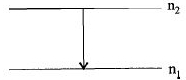
A hydrogen atom makes a transition from $n = 2$ to  $n = 1$ and emits a photon. This photon strikes a doubly ionized lithium atom $(z = 3)$  in excited state and completely removes the orbiting electron. The least quantum number for the excited state of the ion for the process is
  • A
    $2$
  • $4$
  • C
    $5$
  • D
    $3$

Answer

Correct option: B.
$4$
b
A hydrogen atom makes a transition from $n=2$ to $n=1$

Then wavelength

$=\operatorname{Rcz}^{2} \frac{1}{\mathrm{n}_{1}^{2}}-\frac{1}{\mathrm{n}_{2}^{2}}=\operatorname{Rc}(1)^{2}\left[1-\frac{1}{4}\right]$

$\lambda=\operatorname{Rc}\left[\frac{3}{4}\right]$   ..... $(1)$

Forionized lithium

$\lambda=\operatorname{Rc}(3)^{2}\left[\frac{1}{n^{2}}\right]=\operatorname{Rc} 9\left[\frac{1}{n^{2}}\right]$    ..... $(2)$

$\operatorname{Rc}\left[\frac{3}{4}\right]=\operatorname{Rc9}\left[\frac{1}{n^{2}}\right]$

$\Rightarrow \frac{3}{4}=\frac{9}{n^{2}} \Rightarrow n=\sqrt{12}=2 \sqrt{3}$

The least quantum number must be $4$.
Need a full question paper?

Generate a complete, print-ready paper with questions like this in minutes — across 16+ boards, with answer keys.

Start Generating Free

Similar questions

Two unlike charges of magnitude $q$ are separated by a distance $2d$. The potential at a point midway between them is
The core of a transformer is laminated so that
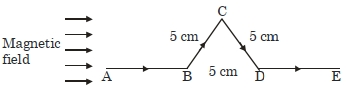
A triangular shaped wire carrying $10 A$ current is placed in a uniform magnetic field of $0.5\,T$, as shown in figure. The magnetic force on segment $CD$ is $....N$ $($ Given $BC = CD = BD =5\,cm )$.
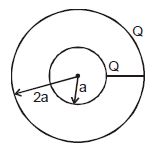
Figure shows a solid metal sphere of radius $‘a’$ surrounded by a concentric thin metal shell of radius $2a$ . Initially both are having charges $Q$ each. When the two are connected by a conducting wire as shown in the figure, then amount of heat produced in this process will be 
In Wheatstone's bridge $P = 9\, ohm$, $Q = 11\, ohm$, $R = 4\,ohm$ and $S = 6\,ohm$. How much resistance must be put in parallel to the resistance $S$ to balance the bridge ............... $ohm$
A bar magnet is placed north-south with its north pole due north. The points of zero magnetic field will be in which direction from the centre of the magnet
Three point charges of magnitude $5 \mu C , 0.16 \mu C$ and $0.3 \mu C$ are located at the vertices $A , B , C$ of a right angled triangle whose sides are $AB =3\,cm$, $BC =3 \sqrt{2}\,cm$ and $CA =3\,cm$ and point $A$ is the right angle corner. Charge at point $A$ experiences

$N$ of electrostatic force due to the other two charges.

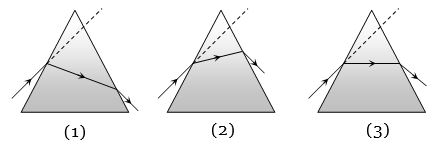
The figures represent three cases of a ray passing through a prism of angle $A.$ The case corresponding to minimum deviation is
A moving charge will gain energy due to the application of
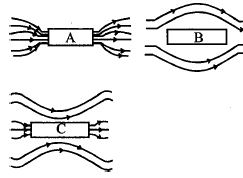
Three identical bars $A, B$ and $C$ are made of different magnetic materials. When kept in a uniform magnetic field, the field lines around them look as follows: Make the correspondence of these bars with their material being diamagnetic $(D)$, ferromagnetic $(F)$ and paramagnetic $(P)$