Question
A hydrogen atom moving at speed υ collides with another hydrogen atom kept at rest. Find the minimum value of υ for which one of the atoms may get ionized. The mass of a hydrogen atom = 1.67 × 10⁻²⁷kg.

Answer

The hydrogen atoms after collision move with speeds v1 and v2
$\text{mv}=\text{mv}_1+\text{mv}_2\ ....(\text{i})$
$\frac{1}{2}\text{mv}^2=\frac{1}{2}\text{mv}^2_1+\frac{1}{2}\text{mv}^2_2+\Delta\text{E}\ ....(\text{ii})$
From (i), $\text{v}^2=(\text{v}_1+\text{v}_2)^2=\text{v}^2_1+\text{v}^2_2+2\text{v}_1\text{v}_2$
From (ii), $\text{v}^2=\text{v}^2_1+\text{v}^2_2+\frac{2\Delta\text{E}}{\text{m}}$
$=2\text{v}_1\text{v}_2=\frac{2\Delta\text{E}}{\text{m}}\ ...(\text{iii})$
$(\text{v}_1-\text{v}_2)^2=\big(\text{v}_1+\text{v}_2\big)^2-4\text{v}_1\text{v}_2$
$(\text{v}_1-\text{v}_2)=\text{v}^2-\frac{4\Delta\text{E}}{\text{m}}$
For minimum value of ‘v’
$\text{v}_1=\text{v}_2$
$\text{v}^2-\Big(\frac{4\Delta\text{E}}{\text{m}}\Big)=0$
$\text{v}^2=\frac{4\Delta\text{E}}{\text{m}}=\frac{4\times13.6\times1.6\times10^{-19}}{1.67\times10^{-27}}$
$\text{v}=\sqrt{\frac{4\times13.6\times1.6\times10^{-19}}{1.67\times10^{-27}}}=7.2\times10^4\text{m/s}$

Need a full question paper?

Generate a complete, print-ready paper with questions like this in minutes — across 16+ boards, with answer keys.
Start Generating Free

Similar questions

The densities of wood and benzene at 0°C are 880kg m-3 and 900kg m-3 respectively. The coefficients of volume expansion are 1.2 × 10⁻³ °C-1 for wood and 1.5 × 10⁻³ °C-1 for benzene. At what temperature will a piece of wood just sink in benzene?
The equation of motion of a particle started at t = 0 is given by $\text{x}=5\sin\big(20\text{t}+\frac{\pi}{3}\big)$ where x is in centimetre and t in second. When does the particle.
  1. First come to rest.
  2. First have zero acceleration.
  3. First have maximum speed?
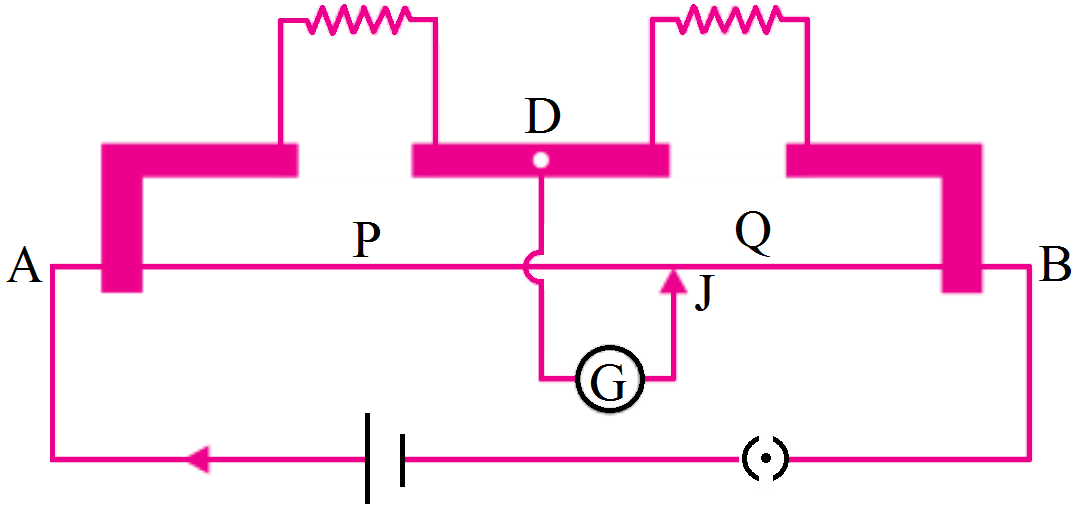
In a practical Wheatstone bridge circuit, wire AB is 2m long. When resistance Y = 2.0W and jockey is in position J such that AJ = 1.20m, there is no current in galvanometer, find the value of unknown resistance X. The resistance per unit length of wire AB = 0.01W/cm. Also calculate the current drawn by the cell of emf 4.0V and negligible internal resistance.

When an electron goes from the valence band to the conduction band in silicon, its energy is increased by 1.1eV. The average energy exchanged in a thermal collision is of the order of kT which is only 0.026eV at room temperature. How is a thermal collision able to take some of the electrons from the valence band to the conduction band?
Show that average value of radiant flux density ‘S’ over a single period ‘T’ is given by $\text{S}=\frac{1}{2\text{c}\mu_0}\text{E}_0^2$.
A long solenoid 'S' has 'n' turns per meter, with diameter 'a'. At the centre of this coil we place a smaller coil of 'N' turns and diameter 'b' (where b < a). If the current in the solenoid increases linearly, with time, what is the induced emf appearing in the smaller coil. Plot graph showing nature of variation in emf, if current varies as a function of mt2 +C.
An eye can distinguish between two points of an object if they are separated by more than 0.22mm when the object is placed at 25cm from the eye. The object is now seen by a compound microscope having a 20D objective and 10D eyepiece separated by a distance of 20cm. The final image is formed at 25cm from the eye. What is the minimum separation between two points of the object which can now be distinguished?
Suppose India had a target of producing by 2020 AD, 200,000 MW of electric power, ten percent of which was to be obtained from nuclear power plants. Suppose we are given that, on an average, the efficiency of utilization (i.e. conversion to electric energy) of thermal energy produced in a reactor was 25%. How much amount of fissionable uranium would our country need per year by 2020? Take the heat energy per fission of $^{235}\text{U}$ to be about 200MeV.
Consider the situation of the previous problem. If $1.0\mu\text{C}$ is placed on the upper plate instead of the middle, what will be the potential difference between:
  1. The upper and the middle plates?
  2. The middle and the lower plates?
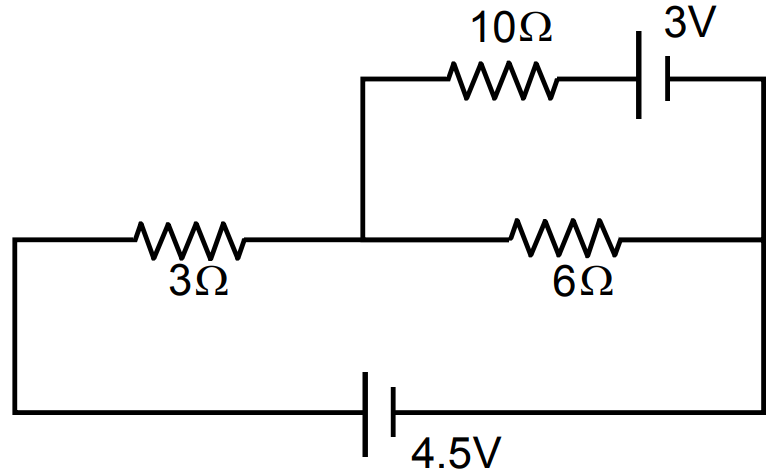
Find the current through the $10\Omega$ resistor shown in figure.