MCQ
A is the fundamental quantity. Here, $A$ refers to:
  • Mass.
  • B
    Velocity.
  • C
    Acceleration.
  • D
    Linear momentum.

Answer

Correct option: A.
Mass.
Mass is the fundamental quantity as it does not depend upon other physical quantities. However, other three quantities, i.e. velocity, acceleration and linear momentum are not fundamental quantities as these show their dependency on fundamental quantities.

Need a full question paper?

Generate a complete, print-ready paper with questions like this in minutes — across 16+ boards, with answer keys.
Start Generating Free

Similar questions

The temperature of water at the surface of a deep lake is $2^\circ C.$ The temperature expected at the bottom is:
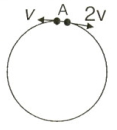
Two small particles of equal masses start moving in opposite directions from a point $A$ in a horizontal circular orbit. Their tangential velocities are $v$ and $2 v$, respectively, as shown in the figure. Between collisions, the particles move with constant speeds. After making how many elastic collisions, other than that at $A$, these two particles will again reach the point $A$ ?
Which of the following diagrams $($figure$)$ depicts ideal gas behaviour?
A cricketer can throw a ball to a maximum horizontal distance of $100\, m .$ The speed with which he throws the ball is (to the nearest integer)  (in $ms ^{-1}$)
A solid sphere, of radius $R$ acquires a terminal velocity $\nu_1 $ when falling (due to gravity) through a viscous fluid having a coefficient of viscosity $\eta $. The sphere is broken into $27$ identical solid spheres. If each of these spheres acquires a terminal velocity, $\nu_2$, when falling through the same fluid, the ratio $(\nu_1/\nu_2)$ equals
A load of $2 \,kg$ produces an extension of $1 \,mm$ in a wire of $3 \,m$ in length and $1 \,mm$ in diameter. The Young's modulus of wire will be .......... $Nm ^{-2}$
Three liquids of densities $d,\,2d$ and $3d$ are mixed in equal volumes. Then the density of the mixture is
The efficiency of a frictionless engine can be 100% only when the heat sink is:
The driver of an express train suddenly sees the red light signal $50m$ ahead and applies the brakes. If the average deceleration during braking is $10.0\ ms^{-2}$ and the reaction time of the driver is $0.75\sec$, the minimum speed at which the train should be moving so as not to cross the red signal is:
A lift performs the first part of its ascent with uniform acceleration $a$ and the remaining with uniform retardation $2a$. If $t$ is the time of ascent, find the depth of the shaft.