MCQ
A jet plane flies in the air because
  • A
    The gravity does not act on bodies moving with high speeds
  • The thrust of the jet compensates for the force of gravity
  • C
    The flow of air around the wings causes an upward force, which compensates for the force of gravity
  • D
    The weight of air whose volume is equal to the volume of the plane is more than the weight of the plane
Answer

Correct option: B.
The thrust of the jet compensates for the force of gravity
b
(b) Initially, when the plane is taking off, thrust force is more than the force of gravity. When it is in the air, the force of gravity is compensated by the thrustof the jet. And when the plane lands, at that point of time, the thrust force is less than the force of gravity.

Need a full question paper?

Generate a complete, print-ready paper with questions like this in minutes — across 16+ boards, with answer keys.

Start Generating Free

Similar questions

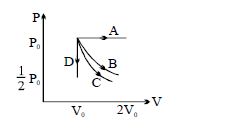
The $PV$ diagram shows four different possible reversible processes performed on a monatomic ideal gas. Process $A$ is isobaric (constant pressure). Process $B$ is isothermal (constant temperature). Process $C$ is adiabatic. Process $D$ is isochoric (constant volume). For which process$(es)$ does the temperature of the gas decrease?
When energy of a satellite-planet system is positive then satellite will .......
A projectile moving vertically upwards with a velocity of $200\, ms^{-1}$ breaks into two equal parts at a height of $490\, m$. One part starts moving vertically upwards with a velocity of $400\, ms^{-1}$. How much time it will take, after the break up with the other part to hit the ground? .............. $\mathrm{s}$
When the temperature of a metal wire is increased from $0^{\circ} \,C$ to $10^{\circ}\, C$, its length increases by $0.02 \% .$ The percentage change in its mass density will be closest to:
In a simple harmonic motion:
  1. The maximum potential energy equals the maximum kinetic energy.
  2. The minimum potential energy equals the minimum kinetic energy.
  3. The minimum potential energy equals the maximum kinetic energy.
  4. The maximum potential energy equals the minimum kinetic energy.
A mass of $0.2\,kg$ is attached to the lower end of a massless spring of force-constant $200\, N/m,$ the upper end of which is fixed to a rigid support. Which of the following statements is/are true ?
The densities of two solid spheres $A$ and $B$ of the same radii $R$ vary with radial distance $r$ as $\rho_A(r)=$ $k \left(\frac{ r }{ R }\right)$ and $\rho_B( r )= k \left(\frac{ r }{ R }\right)^5$, respectively, where $k$ is a constant. The moments of inertia of the individual spheres about axes passing through their centres are $I_A$ and $I_B$, respectively. If $\frac{I_B}{I_A}=\frac{n}{10}$, the value of $n$ is
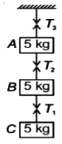
The value of $\frac{T_3}{T_1}$ is .............
What is the torque of the force $\mathop F\limits^ \to   = (2\hat i - 3\hat j + 4\hat k)N$ acting at the pt. $\mathop r\limits^ \to   = (3\hat i + 2\hat j + 3\hat k)\,m$ about the origin
Two billiard balls of mass $0.05\,kg$ each moving in opposite directions with $10\,ms ^{-1}$ collide and rebound with the same speed. If the time duration of contact is $t=0.005\,s$, then $\dots N$is the force exerted on the ball due to each other.