Question
A juggler throws balls vertically upwards with same initial velocity in air. When the first ball reaches its highest position, he throws the next ball. Assuming the juggler throws $n$ balls per second, the maximum height the balls can reach is
Answer

Time taken by ball to reach highest point $=\frac{ u }{ g }$

Frequency of throw $=\frac{ g }{ u }= n$

$u =\frac{ g }{ n }$

$H _{\max }=\frac{ u ^{2}}{2 g }=\frac{\left(\frac{ g }{ n }\right)^{2}}{2 g }$

$\frac{g}{2 n^{2}}$

Need a full question paper?

Generate a complete, print-ready paper with questions like this in minutes — across 16+ boards, with answer keys.

Start Generating Free

Similar questions

Solar energy is incident normally on the earth's surface at the rate of about $1.4 \,kW m m ^{-2}$. The distance between the earth and the sun is $1.5 \times 10^{11} \,m$. Energy $E$ and mass $m$ are related by Einstein equation $E=m c^2$, where $c=3 \times 10^8 \,ms ^{-1}$ is the speed of light in free space. The decrease in the mass of the sun is ........... $\,kg s ^{-1}$
When temperature of an ideal gas is increased from $27^\circ C$ to $227^\circ C$, its $r.m.s.$ speed changed from $400\, metre/sec$ to ${V_s}.$ The ${V_s}$ is ........ $metre/sec$
The equation $\frac{{dV}}{{dt}} = At - BV$ is describing the rate of change of velocity of a body falling from rest in a resisting medium. The dimensions of $A$ and $B$ are
A player with $3$ m long iron rod runs towards east with a speed of $30$ km/hr. Horizontal component of earth's magnetic field is $4 \times {10^{ - 5}}Wb/{m^2}$. If he is running with rod in horizontal and vertical positions, then the potential difference induced between the two ends of the rod in two cases will be
The horizontal range is four times the maximum height attained by a projectile. The angle of projection is ......... $^o$
What is the number of significant figures in $ 0.310\times 10^3$
A circular coil of wire consisting of 100 turns, each of radius 8.0 cm carries a current of 0.40 A. What is the magnitude of the magnetif field B at the centre of the coil ?
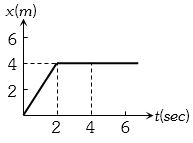
In the figure given below, the position-time graph of a particle of mass $0.1 \,Kg$ is shown. The impulse at $t = 2\sec $ is .......... $kg\,m\,{\sec ^{ - 1}}$
A bullet of mass $m$ travelling at speed $v$ strikes a block of mass $M$ at rest and gets  embedded in it. Finally both will have combined kinetic energy :-
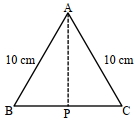
Cross-section view of a prism is the equilateral triangle ${ABC}$ in the figure. The minimum deviation is observed using this prism when the angle of incidence is equal to the prism angle. The time taken by light to travel from midpoint of ${BC}$ to ${A}$ is $.....\times 10^{-10}\, {s}$. $($ Given, speed of light in vacuum $=3 \times 10^{8} \,{m} / {s}$ and $\left.\cos 30^{\circ}=\frac{\sqrt{3}}{2}\right)$