Question
A lady cannot see objects closer than 40cm from the left eye and closer than 100cm from the right eye. While on a mountaineering trip, she is lost from her team. She tries to make an astronomical telscope from her reading glasses to look for her teammates.
  1. Which glass should she use as the eyepiece?
  2. What magnification can she get with relaxed eye?
Answer

The lady can not see objects closer than 40cm from the left eye and 100cm from the right eye.For the left glass lens,
v = -40cm,
u = -25cm
$\therefore \frac{1}{\text{f}}=\frac{1}{\text{v}}-\frac{1}{\text{u}}=\frac{1}{-40}-\frac{1}{-25}=\frac{1}{25}-\frac{1}{40}=\frac{3}{200}$
$\Rightarrow \text{f}=\frac{200}{3}\text{cm}$
For the right glass lens,
v = -100cm,
u = -25cm
$\frac{1}{\text{f}}=\frac{1}{\text{v}}-\frac{1}{\text{u}}=\frac{1}{-100}-\frac{1}{-25}=\frac{1}{100}=\frac{3}{100}$
$\Rightarrow\text{f}=\frac{100}{3}\text{cm}$
  1. For an astronomical telescope, the eye piece lens should have smaller focal length. So, she should
use the right lens $\big(\text{f}=\frac{100}{3}\text{cm}\big)$ as the eye piece lens.
  1. With relaxed eye, (normal adjustment)
$\text{f}_0=\frac{200}{3}\text{cm}$
$\text{f}_\text{e}=\frac{100}{3}\text{cm}$
magnification $=\text{m}=\frac{\text{f}_0}{\text{f}_\text{e}}=\frac{\big(\frac{200}{3}\big)}{\big( \frac{100}{3}\big)}=2$

Need a full question paper?

Generate a complete, print-ready paper with questions like this in minutes — across 16+ boards, with answer keys.

Start Generating Free

Similar questions

The combination of two bar magnets makes 10 oscillations per second in an oscillation magnetometer when like poles are tied together and 2 oscillations per second when unlike poles are tied together. Find the ratio of the magnetic moments of the magnets. Neglect any induced magnetism.
Why is the linear portion of the triode characteristic chosen to operate the triode as an amplifier?
On a winter day when the atmospheric temperature drops to $-10^\circ C$, ice forms on the surface of a lake.
  1. Calculate the rate of increase of thickness of the ice when $10cm$ of ice is already formed.
  2. Calculate the total time taken in forming $10cm$ of ice. Assume that the temperature of the entire water reaches $0^\circ C$ before the ice starts forming. Density of water = $1000kgm^{-3}$, latent heat of fusion of ice $=3.36\times10^5\text{Jkg}^{-1}$ and thermal conductivity of ice $=1.7\text{Wm}^{-1}{^{\circ}}\text{C}^{-1}.$ Neglect the expansion of water on freezing.
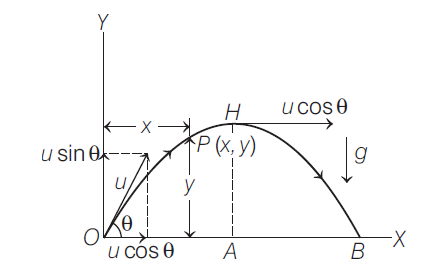
Read the passage given below and answer the following questions from 1 to 5. Projectile motion is a form of motion in which an object or particle is thrown with some initial velocity near the earth’s surface and it moves along a curved path under the action of gravity alone. The path followed by a projectile is called its trajectory, which is shown below. When a projectile is projected obliquely, then its trajectory is as shown in the figure below. Here velocity u is resolved into two components, we get (a) u cosθ along OX and (b) u sinθ along OY.
  1. The example of such type of motion is:
  1. Motion of car on a banked road.
  2. Motion of boat in sea.
  3. A javelin thrown by an athlete.
  4. Motion of ball thrown vertically upward.
  1. The acceleration of the object in horizontal direction is:
  1. Constant
  2. Decreasing
  3. Increasing
  4. Zero
  1. The vertical component of velocity at point H is:
  1. Maximum
  2. Zero
  3. Double to that at O
  4. Equal to horizontal component
  1. A cricket ball is thrown at a speed of 28m/s in a direction 30° with the horizontal. The time taken by the ball to return to the same level will be:
  1. 2.0s
  2. 3.0s
  3. 4.0s
  4. 2.9s
  1. In above case, the distance from the thrower to the point where the ball returns to the same level will be:
  1. 39m
  2. 69m
  3. 68m
  4. 72m
In tug of war, the team that exerts a larger tangential force on the ground wins. Consider the period in which a team is dragging the opposite team by applying a larger tangential force on the ground. List which of the following works are positive, which are negative and which are zero?
  1. Work by the winning team on the losing team.
  2. Work by the losing team on the winning team.
  3. Work by the ground on the winning team.
  4. Work by the ground on the losing team.
  5. Total external work on the two teams.
The plate resistance of a triode is $8\text{k}\Omega$ and the transconductance is 2.5 milliohm. (a) If the plate voltage is increased by 48V and the grid voltage is kept constant, what will be the increase in the plate current? (b) With plate voltage kept constant at this increased value, by how much should the grid voltage be decreased in order to bring the plate current back to its initial value?
When you push your bicycle up on an incline the potential energy of the bicyle and yourself increases. Where does this energy come from?
Read the passage given below and answer the following questions from (i) to (v). Maximum absolute error in the sum or difference of two quantities is equal to sum of the absolute error in the individual quantities, i.e. Z = A + B, then, $\pm\triangle\text{Z}=\pm\triangle\text{A}\pm\text{B}$ Maximum fractional error in a product or division of quantities is equal to the sum of fractional errors in the individual quantities i.e. AB or $\frac{\text{A}}{\text{B}},$ then, $\frac{\triangle\text{Z}}{\text{Z}}=\pm\frac{\triangle\text{A}}{\text{A}}+\frac{\triangle\text{B}}{\text{B}}$ Two resistors of resistances $\text{R}_1=100\pm3\Omega$ are connected (a) in series and (b) in parallel.
  1. The percentage error in the value of $R_1$ is:
  1. 3%
  2. 4%
  3. 6%
  4. 0.3%
  1. The fractional error in the value of $R_2$ is:
  1. $\frac{1}{40}$
  2. $\frac{1}{50}$
  3. $\frac{1}{100}$
  4. $\frac{1}{200}$
  1. Find the equivalent resistance of the series combination.
  1. $(250\pm7)\Omega$
  2. $(320\pm6)\Omega$
  3. $(300\pm7)\Omega$
  4. $(300\pm1)\Omega$
  1. The percentage error in equivalent resistance in series combination is:
  1. 2%
  2. 2.3%
  3. 2.5
  4. 3%
  1. Find the equivalent resistance of the parallel combination having error of $1.8\Omega.$
  1. $(66\pm1)\Omega$
  2. $(66.7\pm1.18)\Omega$
  3. $(66.3\pm2)\Omega$
  4. $(67\pm3)\Omega$
How will the thermionic current vary if the filament current is increased?
The plate current in a diode is 20mA when the plate voltage is 50V or 60V. What will be the current if the plate voltage is 70V?