MCQ
A large difference between the fourth and fifth ionization energies indicates the presence  of
  • A
    $5$ valence electrons in an atom
  • B
    $6$ valence electrons in an atom
  • $4$ valence electrons in an atom
  • D
    $8$ valence electrons in an atom

Answer

Correct option: C.
$4$ valence electrons in an atom
c
The large difference between fourth and fifth ionization energies is due to The Atom can have $4$ electron excess to get stable. On losing the $4$ electrons it gets stability. So it cannot able to lose another electron easily that's why it has high fifth $I.P$

Need a full question paper?

Generate a complete, print-ready paper with questions like this in minutes — across 16+ boards, with answer keys.

Start Generating Free

Similar questions

What is the dominant intermolecular force or bond that must be overcome in converting liquid $CH_3OH$ to a gas?
Which acid is formed by ${P_2}{O_3}$
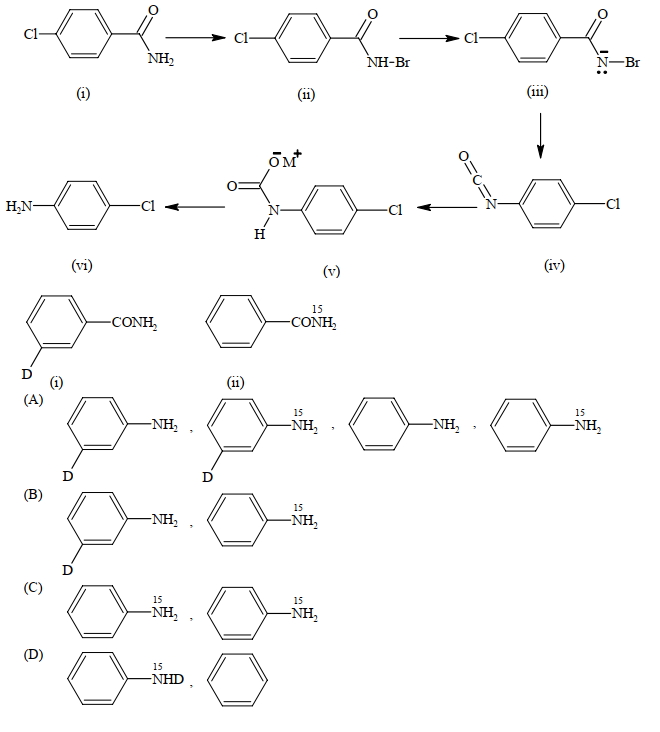
$\mathrm{RCONH}_2$ is converted into $\mathrm{RNH}_2$ by means of Hofmann bromamide degradation.

$Image$

In this reaction, $\mathrm{RCONHBr}$ is formed from which this reaction has derived its name. Electron donating group at phenyl activates the reaction. Hofmann degradation reaction is an intramolecular reaction.

$1.$  How can the conversion of $(i)$ to $(ii)$ be brought about?

$(A)$ $\mathrm{KBr}$  $(B)$ $\mathrm{KBr}+\mathrm{CH}_3 \mathrm{ONa}$  $(C)$ $\mathrm{KBr}+\mathrm{KOH}$  $(D)$ $\mathrm{Br}_2+\mathrm{KOH}$

$2.$  Which is the rate determining step in Hofmann bromamide degradation?

$(A)$ Formation of $(i)$  $(B)$ Formation of $(ii)$  $(C)$ Formation of $(iii)$  $(D)$ Formation of $(iv)$

$3.$  What are the constituent amines formed when the mixture of $(i)$ and $(ii)$ undergoes Hofmann bromamide degradation?

$Image$

give the answer question $1$, $2$, and $3.$
An aqueous solution containing compounds $A$ and $B$ shows optical activity. $A$ and $B$ are stereoisomers. Which of the following possibilities cannot be  correct ? 
Phosphorus is manufactured by heating in a electric furnace a mixture of
The molal elevation constant is the ratio of the elevation in B.P. to
Reaction of $x g$ of $Sn$ with $HCl$ quantitatively produced a salt. Entire amount of the salt reacted with $y g$ of nitrobenzene in the presence of required amount of $HCl$ to produce $1.29 g$ of an organic salt (quantitatively).

($1$) The value of $x$ is. . . . . 

($2$) The value of $y$ is. . . . . 

$(NH_4)_2Cr_2O_7$ (Ammonium dichromate) is used in fire works. The green coloured powder blown in air is
How many structural isomers of amine from $C_3H_9N$ are possible :-
Which of the following reaction is an elimination reaction ?